Egyptian Arabic vs Standard Arabic: Key Differences Explained
Learn Arabic from a textbook, then walk into a café in Cairo, and you may not understand the conversation. That’s not a failure. Egyptians speak Egyptian Arabic in daily life, and school Arabic, Modern Standard Arabic, is mostly for writing, news and formal speech.
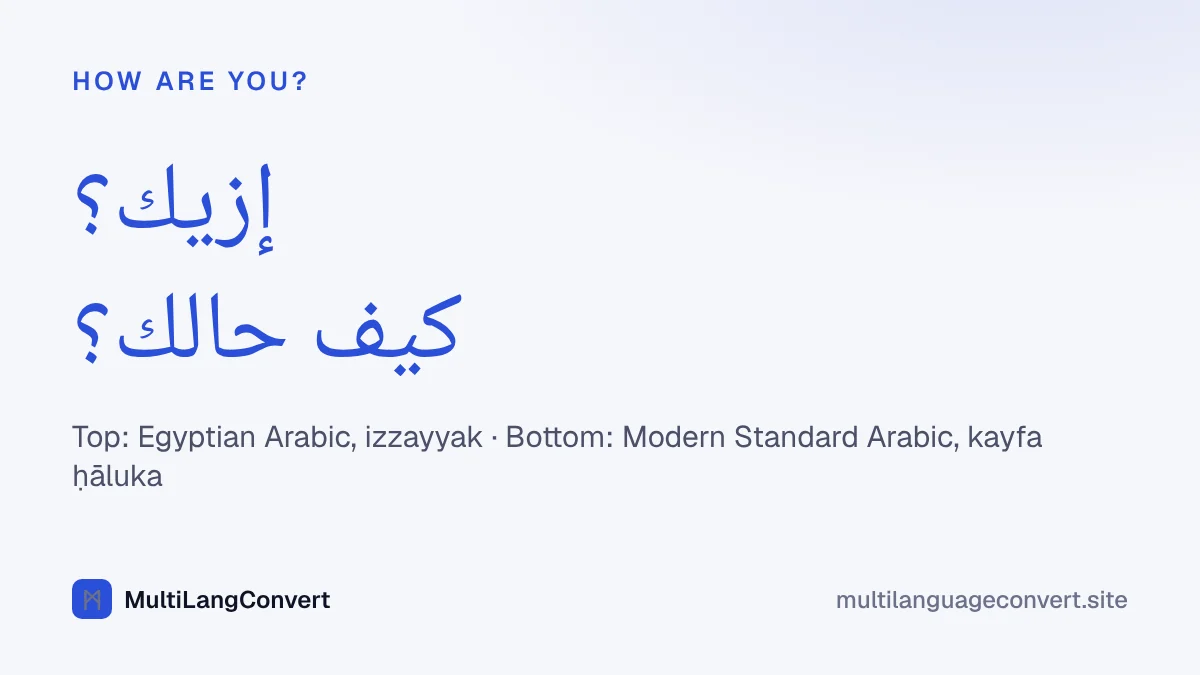
The short answer: Modern Standard Arabic (MSA, al-fuṣḥā) is the formal written Arabic shared by all Arab countries. Egyptian Arabic (Maṣri or ʿāmmiyya) is the spoken language of Egypt, with its own pronunciation, everyday words and simpler grammar. Thanks to Egyptian films, music and TV, it’s the most widely understood Arabic dialect across the Arab world.
What is Egyptian Arabic?
Egyptian Arabic is the vernacular spoken by most of Egypt’s population of over 100 million people. Encyclopaedia Britannica’s entry on Egypt notes that the spoken language differs greatly from the literary language, and that the Cairo dialect, through the country’s film industry, is widely understood throughout the Arab world.
It isn’t one uniform variety. Cairo Arabic is the prestige form and the one taught to learners. Upper Egypt (the Saʿīdi south) and the Bedouin of Sinai and the deserts speak noticeably different dialects.
Egyptian Arabic absorbed words from many languages over the centuries: Coptic, Turkish, Italian, French and English. A Coptic substrate shows in some everyday words, a reminder that Coptic was Egypt’s main language before Arabic spread after the 7th-century conquest.
What is Modern Standard Arabic?
MSA is the modern form of Classical Arabic, the language of the Qur’an. It’s used for newspapers, books, official documents, news broadcasts, religious sermons and formal speeches in every Arab country.
No one grows up speaking MSA at home. Children learn it at school, which is why linguists describe Arabic as a classic case of diglossia: two forms of one language, used in different situations. The linguist Charles Ferguson used Arabic as one of his four main examples when he introduced the term in 1959.
Egyptian Arabic vs MSA: key differences
| Feature | Modern Standard Arabic | Egyptian Arabic |
|---|---|---|
| Used for | Writing, news, formal speech | Everyday conversation, films, songs, social media |
| Letter ج | j (jamal, camel) | g (gamal) |
| Letter ق | q (qalb, heart) | glottal stop (ʾalb) |
| Letter ث | th (thalātha, three) | t or s (talāta) |
| Word order | Often verb-subject-object | Usually subject-verb-object |
| Present tense | aktubu (I write) | baktib, with b- prefix |
| Future | sa-aktubu | ḥaktib, with ḥa- prefix |
| Negation | lā / lam / laysa | ma…š around the verb (ma-katabtiš, I didn’t write) |
| Case endings | Present in formal reading | None |
Everyday words that differ
| English | MSA | Egyptian Arabic |
|---|---|---|
| What? | mādhā / mā | ʾeh? |
| Where? | ayna | fēn? |
| Now | al-ān | dilwaʾti |
| Very | jiddan | ʾawi |
| I want | urīdu | ʿāyez (m) / ʿayza (f) |
| How are you? | kayfa ḥāluka? | izzayyak? (m) / izzayyik? (f) |
| Like this | hākadhā | kida |
| Not | laysa | miš |
Many MSA words are understood in Egypt, but using them in casual talk sounds formal, like saying “I shall endeavour” instead of “I’ll try”.
Which Arabic should you translate into?
- A message to an Egyptian friend, a caption or a chat: Egyptian Arabic.
- A document, sign, certificate or anything official: MSA.
- Something for readers across many Arab countries: MSA, or Egyptian if it’s informal and entertainment-focused.
- Song lyrics, film dialogue or social media in Egypt: Egyptian Arabic.
Most general translators give MSA by default. Our Egyptian Arabic Translator translates into everyday Cairo Arabic in Arabic script with a Latin transliteration, so you can read it aloud even if you don’t read Arabic.
How is Egyptian Arabic written?
Egyptian Arabic uses the Arabic alphabet, but with no fixed official spelling, because formal writing is in MSA. Writers usually spell words as they sound, keeping the MSA letter where a word has an obvious standard form: ق is often still written even when it’s pronounced as a glottal stop.
Online, many Egyptians also write in “Franco-Arabic” (Arabizi): Latin letters plus numbers for sounds English lacks, such as 3 for ع and 7 for ح. “Ezayak 3amel eh?” means “How are you, what are you up to?”
Common phrases in Egyptian Arabic
| Phrase | Meaning | When to use it |
|---|---|---|
| ṣabāḥ il-kheir | Good morning | Morning greeting; reply ṣabāḥ in-nūr |
| maʿlēš | Never mind / sorry | Small apologies, reassurance |
| yalla | Let’s go / come on | Getting someone moving |
| inšāʾallāh | God willing | Talking about any future plan |
| ḥāḍir | Sure, right away | Agreeing to a request |
| šukran | Thank you | Same as MSA |
Common mistakes when translating into Egyptian Arabic
- Using MSA for casual messages. It reads as stiff and bookish.
- Forgetting gender. “How are you” and “I want” change for men and women.
- Pronouncing ج as j. In Cairo it’s a hard g: Egypt itself is Maṣr, and “camel” is gamal.
- Mixing dialects. Levantine words like shu (“what”) mark the speaker as Syrian or Lebanese, not Egyptian.
Egypt’s older language, Coptic, still survives in church use. For the wider story of Egypt’s scripts, see our guide on how to read Egyptian hieroglyphs.
Putting it together
Modern Standard Arabic is the shared, formal Arabic of writing and news; Egyptian Arabic is the living language of Egyptian homes, streets and screens. They differ in sounds (g for ج, a glottal stop for ق), in common words (ʾeh, fēn, dilwaʾti) and in simpler grammar. Use Egyptian Arabic for anything personal or casual, and MSA for anything official.
Sources
- Encyclopaedia Britannica, “Egypt: Languages“.
- Encyclopaedia Britannica, “Arabic language“.
- Charles A. Ferguson, “Diglossia”, Word 15 (1959): 325–340.
- Martin Hinds and El-Said Badawi, A Dictionary of Egyptian Arabic (Librairie du Liban, 1986).
- Manfred Woidich, Das Kairenisch-Arabische: Eine Grammatik (Harrassowitz, 2006).
- Kees Versteegh, The Arabic Language (2nd ed., Edinburgh University Press, 2014).