What Do the 24 Elder Futhark Runes Mean? A Simple Guide
The Elder Futhark is the oldest runic alphabet, used by Germanic peoples from about the 2nd to the 8th century AD. It has 24 runes, each with a sound and a name, and those names are where the “meanings” people look for come from.
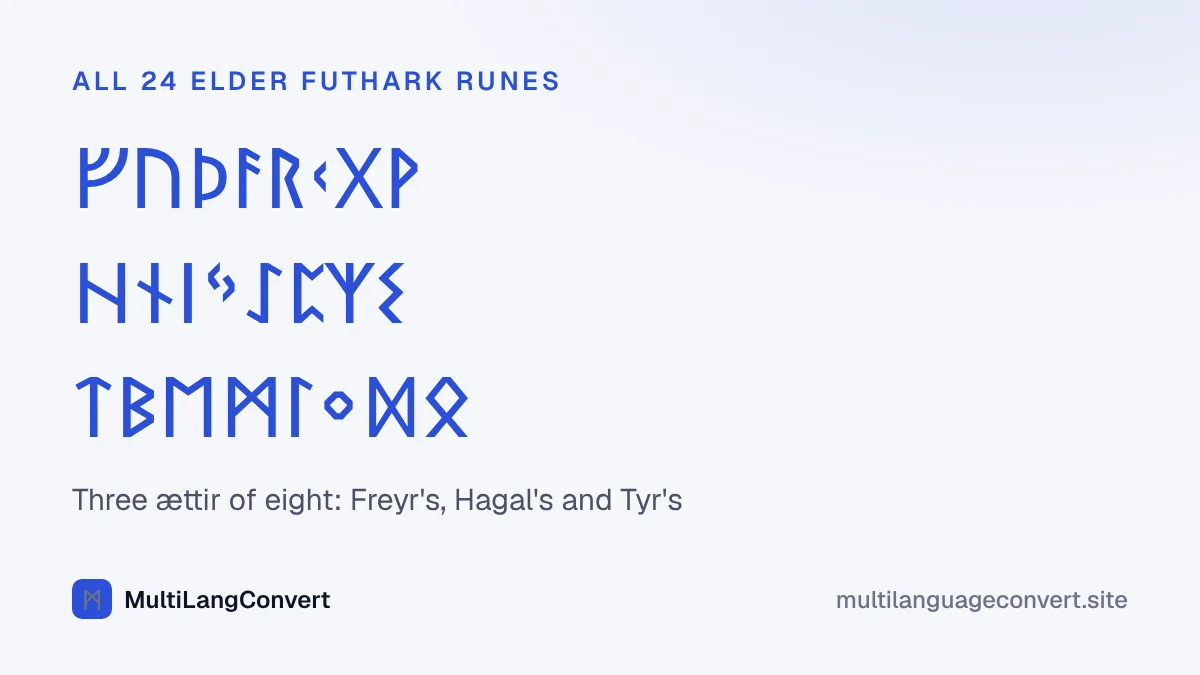
The short answer: each Elder Futhark rune stands for one sound, like a letter, and carries a name that was a real word, such as fehu (cattle, wealth) for ᚠ or ansuz (a god) for ᚨ. The names are reconstructed by scholars from later rune poems, because no complete list survives from the Elder Futhark period itself. This guide gives all 24 runes with their sounds, names and meanings, and explains which parts are history and which are modern interpretation.
What is the Elder Futhark?
The Elder Futhark takes its name from its first six runes: ᚠ f, ᚢ u, ᚦ th, ᚨ a, ᚱ r, ᚲ k. Like “alphabet” from alpha and beta, “futhark” comes from the start of the row.
Its oldest inscriptions date to around AD 150–200, and it was used across Scandinavia, Germany and eastern Europe. The Unicode Runic chart encodes all its letters, so you can type them on a modern computer.
The oldest complete row of all 24 runes is carved on the Kylver Stone from Gotland, Sweden, dated to about AD 400 and now held by the Swedish History Museum. Its maker carved the runes in order, from ᚠ to ᛟ, which is how we know the sequence.
All 24 Elder Futhark runes and their meanings
The runes are traditionally split into three groups of eight, called ættir (families). The names below are the standard scholarly reconstructions in Proto-Germanic.
| Rune | Sound | Name | Meaning of the name |
|---|---|---|---|
| ᚠ | f | fehu | cattle, wealth |
| ᚢ | u | ūruz | aurochs (wild ox) |
| ᚦ | th (þ) | þurisaz | giant |
| ᚨ | a | ansuz | a god (one of the Æsir) |
| ᚱ | r | raidō | riding, journey |
| ᚲ | k | kaunan / kenaz | ulcer, or torch |
| ᚷ | g | gebō | gift |
| ᚹ | w | wunjō | joy |
| ᚺ | h | hagalaz | hail |
| ᚾ | n | naudiz | need, hardship |
| ᛁ | i | īsaz | ice |
| ᛃ | j (y) | jēra | year, harvest |
| ᛇ | ï / æ | īwaz | yew tree |
| ᛈ | p | perþ- | unknown; possibly pear tree |
| ᛉ | z (later R) | algiz | elk, or protection |
| ᛊ | s | sōwilō | sun |
| ᛏ | t | tīwaz | the god Týr |
| ᛒ | b | berkanan | birch |
| ᛖ | e | ehwaz | horse |
| ᛗ | m | mannaz | man, human |
| ᛚ | l | laguz | water, lake |
| ᛜ | ng | ingwaz | the god Ing |
| ᛞ | d | dagaz | day |
| ᛟ | o | ōþila | inherited land, homeland |
The order of the last two runes varies between inscriptions, so you’ll see charts that end ᛞ ᛟ and others that end ᛟ ᛞ. Both are authentic.
Where do the rune meanings come from?
No text from the Elder Futhark period lists the rune names. Scholars reconstruct them from three later medieval poems, each written for a different rune row.
- The Old English Rune Poem (Anglo-Saxon Futhorc, preserved in a 1705 printed copy).
- The Norwegian Rune Poem (Younger Futhark, 13th century).
- The Icelandic Rune Poem (Younger Futhark, 15th century).
When the names agree across all three, as with fé / feoh (wealth) or íss / is (ice), the reconstruction is secure. When they disagree, as with ᚲ (torch in English, ulcer in Norse), scholars list both. ᛈ is the one rune whose name is genuinely unknown.
Runologist R. I. Page, in Runes (British Museum Press, 1987), stresses that these are names for the letters, much like “alpha” or “bee”, and not secret meanings.
Are runes magical?
Some inscriptions show runes used in charms. Words like alu appear on amulets and bracteates (gold pendants), and scholars generally read them as protective formulas. But most surviving inscriptions are ordinary: names, makers’ marks, memorials and short messages.
The modern system of divination meanings, such as ᚹ for “joy and success” or ᛉ for “protection”, comes largely from 20th-century authors, especially Ralph Blum’s The Book of Runes (1982). It’s a modern spiritual practice built on the old names, not a recovered Viking system. It’s fine to use it, as long as you know which is which.
How do you write English in Elder Futhark?
Write by sound, not by spelling. The Elder Futhark has one rune per sound, so English letter combinations need care.
- Split the word into sounds. “Thomas” is t-o-m-a-s, because the th is a plain t sound.
- Use the single runes for th (ᚦ) and ng (ᛜ) when you hear those sounds.
- Replace missing letters. There’s no c, q, v, x or y: use ᚲ for hard c and q, ᚹ or ᚠ for v, ᚲᛊ for x.
- Drop silent letters, like the e in “Kate” or the gh in “knight”.
- Separate words with a dot or colon, as rune carvers often did.
Example: “Freya” becomes ᚠᚱᛖᛃᚨ (f-r-e-j-a). Our Runic Translator does this conversion by sound and lets you check each rune. For the history of how the alphabets split, read Elder Futhark vs Younger Futhark.
Elder Futhark vs other runic alphabets
| Row | Runes | Period | Where |
|---|---|---|---|
| Elder Futhark | 24 | c. 150–750 | Scandinavia, Germany, eastern Europe |
| Anglo-Saxon Futhorc | 26–33 | c. 400–1100 | England, Frisia |
| Younger Futhark | 16 | c. 750–1100 | Viking-Age Scandinavia |
| Medieval runes | about 27 | c. 1100–1500 | Scandinavia |
If your text is Viking-themed, the Younger Futhark is the historically accurate choice. The Elder Futhark is older than the Vikings by several centuries.
Common mistakes with Elder Futhark runes
- Mixing rows. Using a Younger Futhark rune in an Elder Futhark name is like mixing Greek and Latin letters.
- Confusing look-alikes. ᚹ (w) and ᚦ (th), or ᛖ (e) and ᛗ (m), are easy to swap in a design; check each one against a chart.
- Adding letters that don’t exist. Fonts that invent runes for c, q or x are modern.
- Using divination meanings as history. Mention the source if you use modern meanings.
Putting it together
The Elder Futhark is a 24-letter alphabet, first carved around AD 150. Each rune has a sound and a name, reconstructed from medieval rune poems, and the names were ordinary words such as wealth, hail, ice and sun. Write English by sound, keep to one rune row, and treat modern divination meanings as modern.
Sources
- The Unicode Consortium, Runic code chart (U+16A0–U+16FF).
- R. I. Page, Runes (British Museum Press, 1987).
- Michael P. Barnes, Runes: A Handbook (Boydell Press, 2012).
- Elmer H. Antonsen, Runes and Germanic Linguistics (Mouton de Gruyter, 2002).
- Kylver Stone (G 88), Swedish History Museum, Stockholm.
- Bruce Dickins, Runic and Heroic Poems of the Old Teutonic Peoples (Cambridge University Press, 1915), texts of the three rune poems.