Old English vs Middle English: What’s the Difference?
Many people search for an “Old English translator” when they really want Shakespeare-style English, or Chaucer, or the language of Beowulf. These are three different stages of English, and only one of them is truly Old English.
The short answer: Old English (about 450–1100) was the Germanic language of the Anglo-Saxons, written with letters like þ and æ, and it looks almost foreign today. Middle English (about 1100–1500) came after the Norman Conquest, took in thousands of French words and lost most of its word endings, which is why Chaucer is partly readable. This guide shows the differences side by side so you can tell which one you need.
What is Old English?
Old English, also called Anglo-Saxon, is the earliest recorded form of English. It was brought to Britain from the 5th century by settlers from what is now northern Germany and Denmark, the Angles, Saxons and Jutes. Encyclopaedia Britannica describes it as the language spoken and written in England before 1100, with its first great literary period under Alfred the Great in the 9th century.
It was a West Germanic language, closely related to Old Frisian and Old Saxon. Like modern German, it had grammatical gender, case endings on nouns and adjectives, and a flexible word order.
The best-known Old English text is Beowulf, an epic poem of about 3,200 lines that survives in a single manuscript, now in the British Library (Cotton MS Vitellius A XV). Its opening word, Hwæt!, is usually translated “Listen!” or “So!”
What is Middle English?
Middle English is the English of roughly 1100 to 1500, the language of Geoffrey Chaucer, William Langland and the Gawain poet. After William of Normandy won the Battle of Hastings in 1066, French became the language of the ruling class for about three centuries, while ordinary people kept speaking English.
The result was a language that kept its Germanic core but borrowed heavily from French and Latin, and simplified its grammar. By Chaucer’s time, in the late 1300s, English was again used in government, and the London dialect was on its way to becoming the standard.
Old English vs Middle English: the key differences
The quickest way to see the change is to compare the two stages side by side.
| Feature | Old English | Middle English |
|---|---|---|
| Dates | c. 450–1100 | c. 1100–1500 |
| Extra letters | þ (thorn), ð (eth), æ (ash), ƿ (wynn) | þ and ȝ (yogh) still used, slowly replaced by th, gh, y |
| Vocabulary | Almost all Germanic, some Latin and Norse | Thousands of French loanwords added |
| Noun endings | Four cases, three genders | Most endings lost; gender disappears |
| Word order | Flexible, verb often last | Mostly subject-verb-object |
| Famous text | Beowulf | The Canterbury Tales |
| Readable today? | No, must be learned like a foreign language | Partly, with a glossary |
The same sentence in each stage
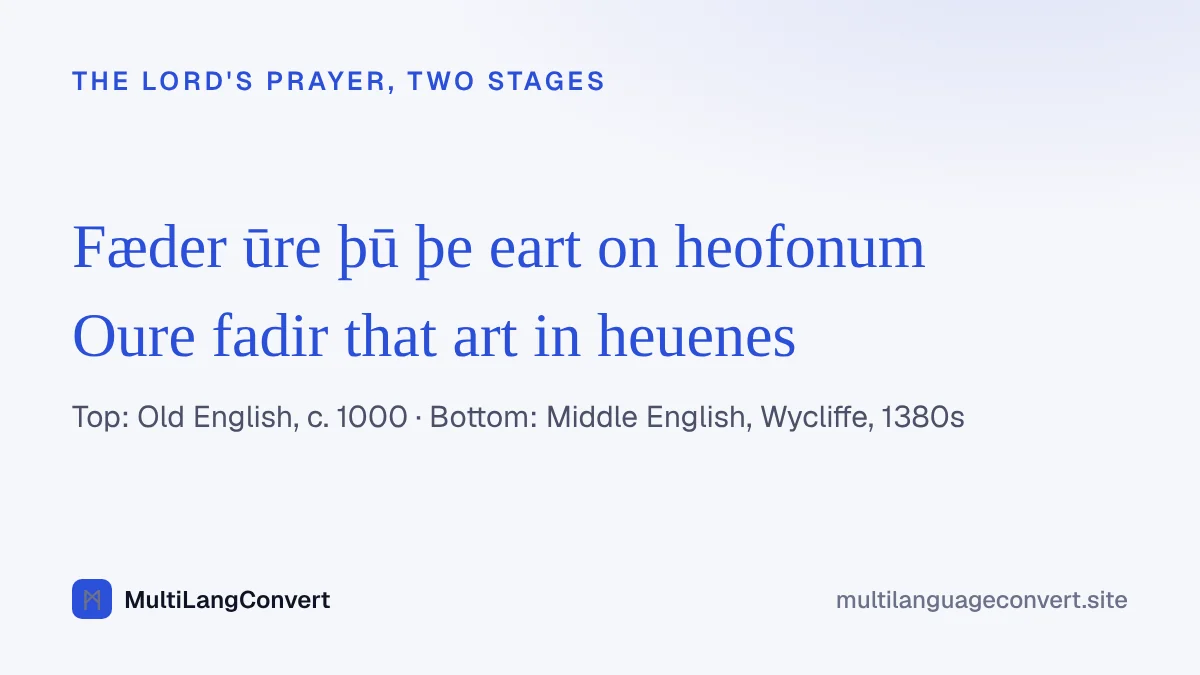
The first line of the Lord’s Prayer shows the change clearly.
| Stage | Text |
|---|---|
| Old English (c. 1000) | Fæder ūre, þū þe eart on heofonum |
| Middle English (Wycliffe, c. 1380s) | Oure fadir that art in heuenes |
| Early Modern English (1611) | Our Father which art in heaven |
The Old English line puts “father” before “our”, uses the letter þ and has a case ending on heofonum. Four centuries later, the Middle English line already looks like the version many people still recite.
Why did Old English change into Middle English?
Three forces did most of the work, and they reinforced each other.
- Viking settlement (from the 9th century). Old Norse speakers settled across northern and eastern England. Norse and Old English shared many root words but had different endings, and historians of English such as Baugh and Cable argue that mixed communities leaned on the shared roots and let the endings blur. English also took everyday words from Norse, including sky, egg, take and even the pronoun they.
- The Norman Conquest (1066). French became the language of law, government and the aristocracy. English borrowed words like court, judge, beef, pork and beauty.
- Loss of a written standard. Before 1066, a West Saxon standard was used for writing. Afterwards, English was written mainly by local scribes, who spelled words as they heard them, so the spoken changes show up on the page.
Here’s what’s surprising: English kept nearly all of its most common words from Old English. The, and, be, have, water, bread, house and love are all Old English. The French layer is large, but it sits on top of a Germanic base.
How can you tell if a text is Old or Middle English?
Look for these clues, in this order.
- Letters æ, ð and ƿ point strongly to Old English. Middle English mostly dropped them, though þ and ȝ lasted longer.
- French words like pilgrimage, vertu or corage mean it is Middle English or later.
- Verb at the end of the clause, as in German, is typical of Old English.
- Spellings you can sound out, like knyght or shoures, are typical of Middle English.
- Thee, thou and -eth appear in both Middle and Early Modern English, so they don’t settle the question by themselves.
Is “Saxon English” the same as Old English?
Yes. “Anglo-Saxon”, “Saxon English” and “Old English” usually refer to the same language. Scholars prefer “Old English” because it shows the link to modern English, but older books and the standard dictionary, Bosworth-Toller’s Anglo-Saxon Dictionary, use the older name.
Old English also had dialects. West Saxon, from the kingdom of Wessex, is the one most texts survive in, so it is what students learn. Northumbrian, Mercian and Kentish differed in spelling and some vocabulary.
Archaic English vs Old English: a common mix-up
“Archaic English” usually means the style of the 1500s and 1600s: thee, thou, hath, doth. That is Early Modern English, the language of Shakespeare and the King James Bible, not Old English.
| If you want… | You need… |
|---|---|
| Beowulf-style, Anglo-Saxon words | Old English |
| Chaucer-style medieval English | Middle English |
| “Thou art” and “thee” for a wedding or fantasy text | Early Modern (Shakespearean) English |
For a full method of reading the middle stage, see our guide on translating Middle English into modern English.
How do you translate English into Old English?
Translating into Old English means choosing native Germanic words and adding the right endings. It is a real translation, not a spelling change.
- Replace French and Latin words with Old English ones. “City” becomes burg, “people” becomes folc, “army” becomes here.
- Add case endings. “To the king” is tō þǣm cyninge, with endings on both “the” and “king”.
- Conjugate verbs. “He goes” is hē gǣþ; “we go” is wē gāþ.
- Check every word in Bosworth-Toller or the Dictionary of Old English at the University of Toronto.
Our Old English Translator does this automatically from a dictionary of Old English words, with case endings and verb forms, and can also show the result in Anglo-Saxon runes. For names, mottos and tattoos, check the result in a dictionary.
Which should you learn first?
If your goal is reading medieval literature, start with Middle English. Chaucer becomes readable within a few weeks, and the skills transfer.
If you’re drawn to Beowulf, runes or the Anglo-Saxon world, go straight to Old English. Expect it to feel like learning German: a grammar, a vocabulary list and plenty of practice. Peter Baker’s Introduction to Old English is a widely used starting textbook.
Putting it together
Old English is the Germanic language of the Anglo-Saxons, with its own letters, endings and verb-final word order. Middle English is what it became after Viking settlement and the Norman Conquest stripped away the endings and added French vocabulary.
So before you translate, decide which stage you really mean. If it has þ, æ and no French words, it’s Old English. If it reads like misspelled modern English, it’s Middle English. If it says “thou art”, it’s Shakespeare’s English, a third stage entirely.
Sources
- Encyclopaedia Britannica, “Old English language” and “Middle English language“.
- Encyclopaedia Britannica, “Old Norse language“.
- British Library, Cotton MS Vitellius A XV (the Beowulf manuscript).
- Bosworth-Toller’s Anglo-Saxon Dictionary online (Charles University, Prague).
- University of Toronto, Dictionary of Old English.
- Peter S. Baker, Introduction to Old English (3rd ed., Wiley-Blackwell, 2012).
- Albert C. Baugh and Thomas Cable, A History of the English Language (6th ed., Routledge, 2013).