What Is Proto-Germanic? The Ancestor of English Explained
English father, German Vater, Dutch vader, Swedish fader, Gothic fadar. The pattern is too regular to be chance. All these words descend from one ancestor, *fadēr, in a language no one ever wrote down: Proto-Germanic.
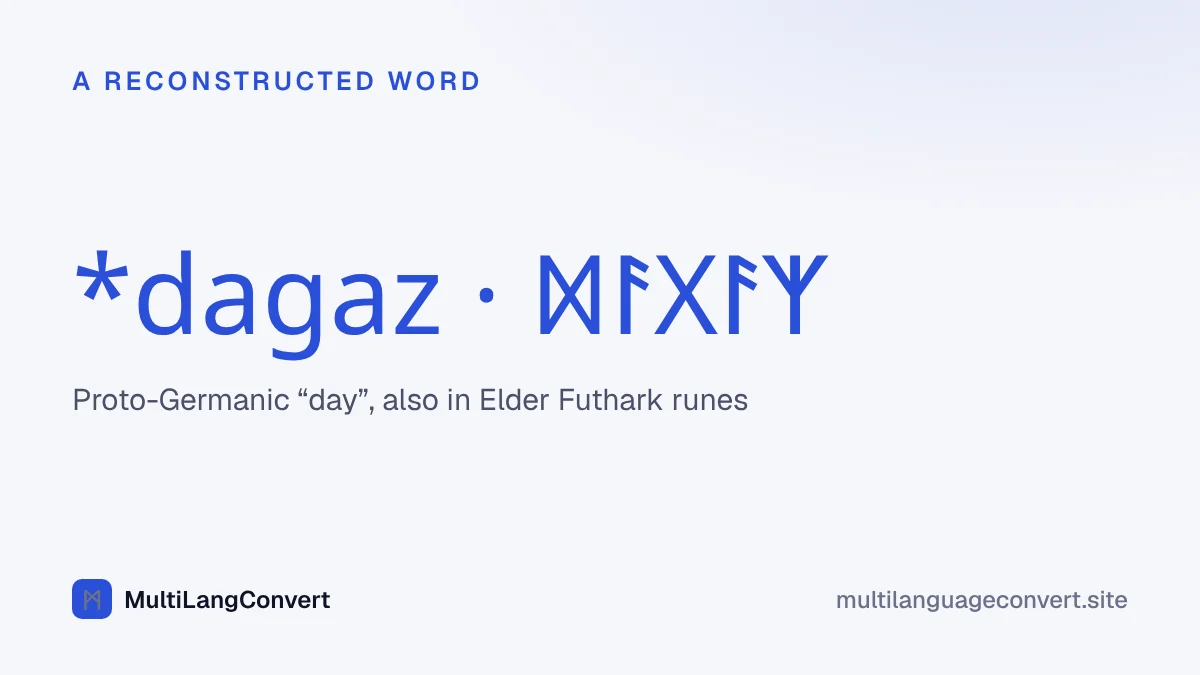
The short answer: Proto-Germanic is the reconstructed common ancestor of the Germanic languages, including English, German, Dutch, the Scandinavian languages and extinct Gothic. It was probably spoken in southern Scandinavia and northern Germany in roughly the last few centuries BC. There are no texts in it, so every word is rebuilt by comparing its descendants, which is why scholars mark Proto-Germanic words with an asterisk (*).
Where does Proto-Germanic fit in?
Proto-Germanic is itself a descendant of Proto-Indo-European, the ancestor of most languages of Europe, Iran and northern India. Encyclopaedia Britannica divides its descendants into three branches.
| Branch | Languages |
|---|---|
| West Germanic | English, German, Dutch, Frisian, Yiddish, Afrikaans |
| North Germanic | Old Norse → Icelandic, Faroese, Norwegian, Swedish, Danish |
| East Germanic | Gothic, Vandalic, Burgundian (all extinct) |
The oldest Germanic texts we have are runic inscriptions in the Elder Futhark, from about AD 150, written in a language very close to late Proto-Germanic (often called Proto-Norse or Northwest Germanic). The Gothic Bible of Bishop Wulfila, from the 4th century, is the earliest long text.
How do linguists reconstruct a language with no texts?
By the comparative method: lining up related words in daughter languages and working out regular sound changes.
| English | German | Old Norse | Gothic | Proto-Germanic |
|---|---|---|---|---|
| father | Vater | faðir | fadar | *fadēr |
| water | Wasser | vatn | watō | *watōr |
| heart | Herz | hjarta | haírtō | *hertǭ |
| day | Tag | dagr | dags | *dagaz |
| king (kin-leader) | König | konungr | — | *kuningaz |
The asterisk means “reconstructed, not attested”. The ending -az on *dagaz shows up as -r in Norse and -s in Gothic, and disappears in English.
Grimm’s Law: what made Germanic different
Proto-Germanic split off from its Indo-European relatives through a set of consonant shifts described by Jacob Grimm (of the fairy tales) in 1822.
| Indo-European sound | Germanic sound | Latin | English |
|---|---|---|---|
| p | f | pater | father |
| t | th | tres | three |
| k | h | centum (k-) | hundred |
| d | t | decem | ten |
| g | k | genu | knee |
That’s why Latin and English cognates so often look shifted: piscis/fish, cornu/horn, duo/two.
What was Proto-Germanic grammar like?
- Cases: nominative, accusative, genitive, dative, plus traces of instrumental and vocative.
- Strong and weak verbs: strong verbs change their vowel for the past (sing/sang), weak verbs add a dental suffix (-d/-t), a Germanic innovation.
- Stress on the first syllable, which later wore away endings in English.
- Three genders and a dual in pronouns.
A sample sentence, using standard reconstructions: *ek gangō, “I go”; *wiz gangamaz, “we go”.
How to translate English into Proto-Germanic
- Find each root in a reference such as Guus Kroonen’s Etymological Dictionary of Proto-Germanic (Brill, 2013).
- Add case endings (e.g. -az for masculine a-stem nominative, -ą accusative).
- Conjugate verbs for person and number.
- Write in Elder Futhark runes for an authentic look: *dagaz → ᛞᚨᚷᚨᛉ.
- Flag uncertainty. Reconstructions differ between scholars, and many modern ideas have no Proto-Germanic word.
Our Proto-Germanic Translator uses a reconstructed word list with case and verb endings, shows the result in Elder Futhark, and keeps any word it can’t reconstruct in English rather than inventing one. For the runes themselves, see the 24 Elder Futhark runes and their meanings.
Putting it together
Proto-Germanic is the unwritten ancestor of English, German and Norse, rebuilt word by word with the comparative method. Grimm’s Law explains its consonants, the asterisk marks its words as reconstructions, and the Elder Futhark runes are the closest thing to its own handwriting.
Sources
- Encyclopaedia Britannica, “Germanic languages“.
- Guus Kroonen, Etymological Dictionary of Proto-Germanic (Brill, 2013).
- Don Ringe, From Proto-Indo-European to Proto-Germanic (2nd ed., Oxford University Press, 2017).
- Jacob Grimm, Deutsche Grammatik (2nd ed., 1822).
- Orrin W. Robinson, Old English and Its Closest Relatives (Stanford University Press, 1992).