How Cuneiform Works: Word Signs, Syllables and Determinatives
Cuneiform is a writing system of wedge-shaped signs pressed into clay. Most signs could stand either for a whole word or for a syllable, and silent signs called determinatives told the reader what kind of word came next. It began in Sumer around 3300 BC and was used for more than 3,000 years to write over a dozen languages.
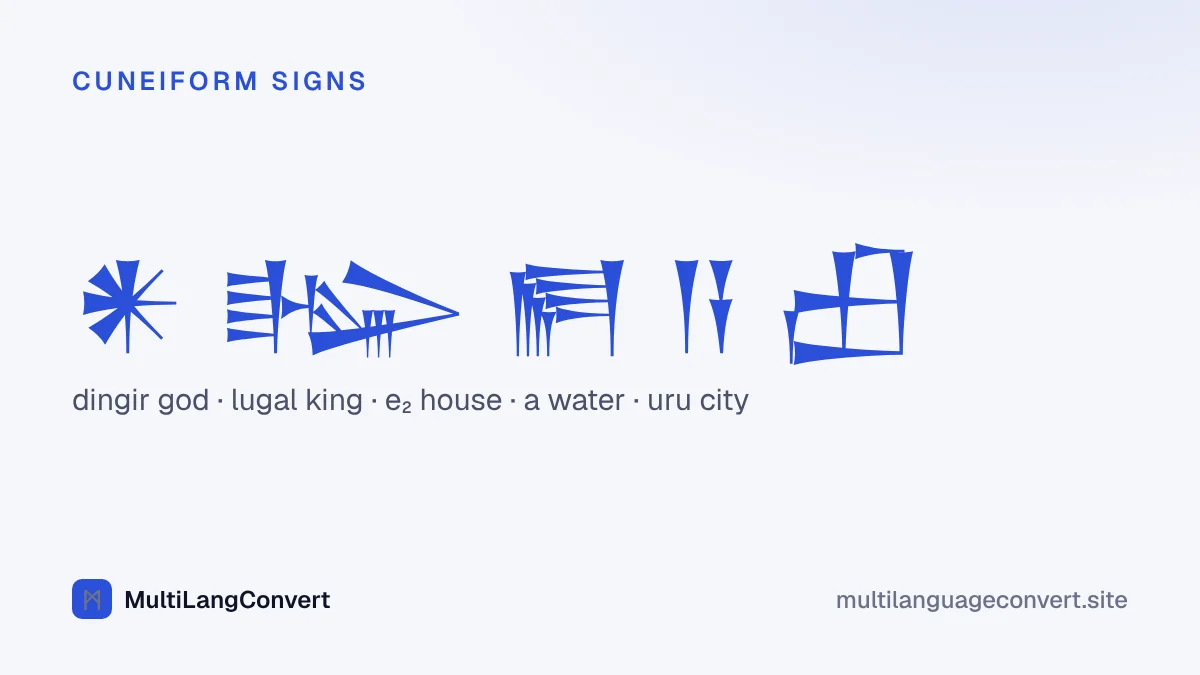
From pictures to wedges
The earliest tablets, from the city of Uruk in what is now southern Iraq, are mostly accounts: numbers of sheep, measures of barley, rations for workers. The signs were simple pictures drawn into damp clay with a pointed tool. Over the following centuries, scribes switched to pressing the end of a cut reed into the clay, which left wedge-shaped marks. The pictures became patterns of wedges and gradually lost their resemblance to the things they showed. Signs were also turned 90 degrees at some point, so the old pictures lie on their sides. The name “cuneiform” comes from Latin cuneus, “wedge”.
Three jobs a sign can do
1. Word signs (logograms)
Many signs stand for a whole word. The star-shaped sign 𒀭 means “sky” or “god”. In transliteration, word signs are written in capital letters with their Sumerian reading: LUGAL for “king”, DINGIR for “god”, KÁ for “gate”.
2. Syllable signs
The same signs could also be used for their sound alone, ignoring the meaning. 𒀭 could simply be the syllable an. Syllable signs come in three main shapes:
| Type | Example | Sign |
|---|---|---|
| Vowel (V) | a | 𒀀 |
| Consonant + vowel (CV) | ba | 𒁀 |
| Vowel + consonant (VC) | ab | 𒀊 |
A word is spelled by chaining syllables, with hyphens in transliteration. Akkadian šarrum (“king”) can be spelled šar-rum or ša-ar-ru-um. A closing consonant is often written with a VC sign that repeats the vowel: sa-am for “sam”. This is how our Cuneiform Translator writes names.
3. Determinatives
Determinatives are silent signs that classify the next (or previous) word. They were not read aloud. In transliteration they are written as small raised letters:
| Determinative | Sign | Placed before | Example |
|---|---|---|---|
| d (DINGIR) | 𒀭 | gods’ names | dmarduk |
| m (DIŠ) | 𒁹 | men’s names | mḫammurapi |
| f (MUNUS) | 𒊩 | women’s names | fšamuramat |
| ki (KI) | 𒆠 | after place names | babiliki |
Why one sign can be read many ways
This is the hardest part for beginners. A single sign often has several syllable values and several word values. Assyriologists tell them apart with numbers and accents: u, ú and ù are three different signs that all read “u”. The reader picks the right value from context. Lists of signs and their values, such as Rykle Borger’s Mesopotamisches Zeichenlexikon, are the standard reference.
Scribes helped readers with phonetic complements: a syllable sign added after a word sign to show its ending. If you see LUGAL-rum, the rum tells you the word is šarrum in the nominative.
How to read a transliteration
Here is a short line in the style of Babylonian inscriptions, with the conventions explained:
dAMAR.UTU be-lum ra-bu-ú
- d is the god determinative.
- AMAR.UTU in capitals is a word written with two signs joined by a full stop: the name Marduk.
- be-lum ra-bu-ú in italics is spelled syllable by syllable: bēlum rabûm, “great lord”.
- ú with an accent is the second sign with the value u.
When the signs are turned into a pronounceable word with long vowels and no hyphens (bēlum), that is called normalisation.
Which languages used cuneiform?
- Sumerian, a language with no known relatives, for which the script was invented.
- Akkadian, a Semitic language, in its Babylonian and Assyrian dialects. It was the diplomatic language of the Near East in the 2nd millennium BC; the Amarna letters between Egypt and its neighbours are in Akkadian cuneiform.
- Hittite in Anatolia, the oldest written Indo-European language with substantial texts.
- Elamite, Hurrian and Urartian, among others.
- Ugaritic and Old Persian used wedge-shaped signs too, but as alphabets or semi-syllabaries invented separately.
The last known cuneiform tablets are astronomical texts from the 1st century AD.
How cuneiform was deciphered
The key was the trilingual inscription carved by the Persian king Darius I on the cliff at Behistun (Bisitun) in Iran, in Old Persian, Elamite and Babylonian. Georg Friedrich Grotefend made the first progress on Old Persian in 1802, and Henry Rawlinson copied the inscription at great personal risk in the 1830s and 1840s. In 1857 the Royal Asiatic Society sent the same newly found Assyrian text to four scholars separately, including Rawlinson, Edward Hincks, Julius Oppert and William Henry Fox Talbot. Their translations largely agreed, which convinced the world that Akkadian could be read.
Try it yourself
Use our Cuneiform Translator to see how a name breaks into syllables. Gilgamesh comes out as 𒄀𒅋𒂵𒈨𒂠 (gi-il-ga-me-eš). In the epic itself, his name is written with word signs as dGIŠ.GÍN.MAŠ, which shows how much a single name could vary across tablets and periods.
Sources
- Cuneiform Digital Library Initiative
- University of Oxford, Electronic Text Corpus of Sumerian Literature
- University of Chicago ISAC, The Assyrian Dictionary (CAD)
- The Unicode Consortium, Cuneiform code chart
- Encyclopaedia Britannica, “Sumerian language“.
- Irving Finkel and Jonathan Taylor, Cuneiform (British Museum Press, 2015).