How to Read Egyptian Hieroglyphs: A Beginner’s Guide
To read Egyptian hieroglyphs, start with three ideas. First, read towards the faces of the people and animals. Second, learn the 24 or so signs that stand for single sounds. Third, remember that most words also contain silent signs that show meaning. With those, you can already pick out royal names on museum objects.
Which way to read
Hieroglyphs can be written in rows or columns, from left to right or from right to left. The signs tell you which: people, animals and birds face the beginning of the line. If the birds look left, start on the left. Columns are always read from top to bottom. Within a row, signs are grouped into neat squares, read top to bottom and front to back.
Scribes chose the direction for looks. On a doorway, the inscriptions on either side often face each other, mirrored, so the whole design is symmetrical.
The hieroglyphic “alphabet”
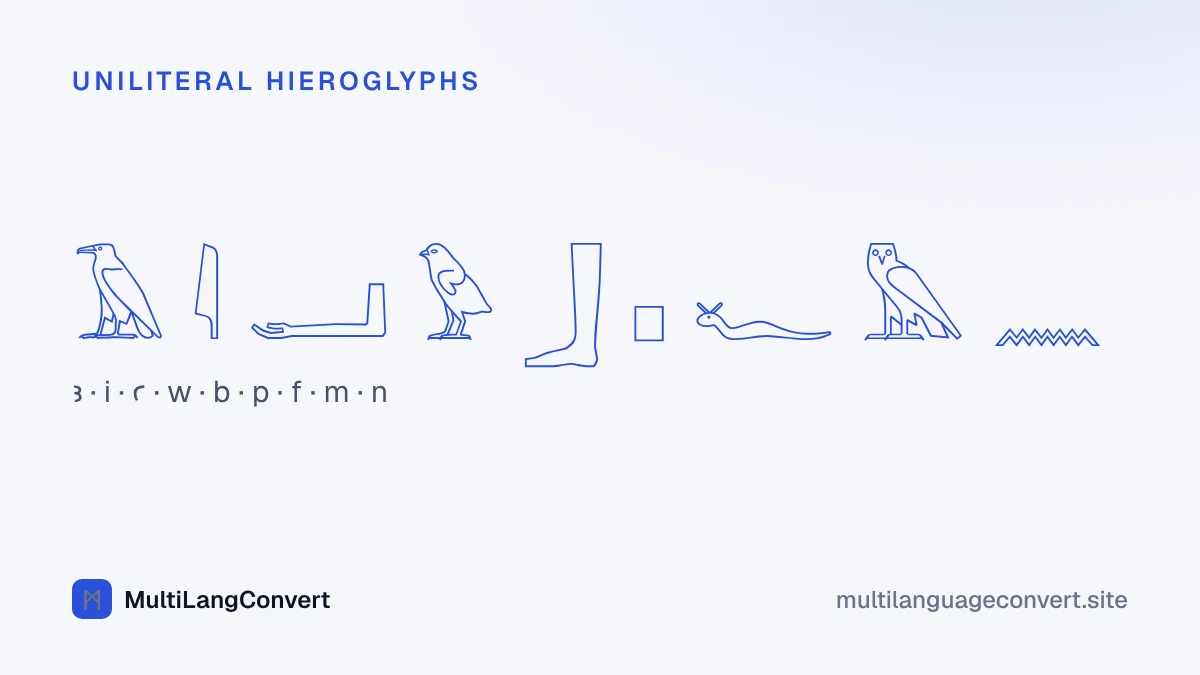
About 24 signs stand for a single consonant. Egyptologists call them uniliteral signs. They are the easiest place to begin.
| Sign | Sound | Shows |
|---|---|---|
| 𓄿 | ꜣ | Egyptian vulture |
| 𓇋 | i | flowering reed |
| 𓂝 | ꜥ | forearm |
| 𓅱 | w | quail chick |
| 𓃀 | b | foot |
| 𓊪 | p | stool |
| 𓆑 | f | horned viper |
| 𓅓 | m | owl |
| 𓈖 | n | water ripple |
| 𓂋 | r | mouth |
| 𓉔 | h | reed shelter |
| 𓎛 | ḥ | twisted flax |
| 𓐍 | ḫ | placenta (?) |
| 𓋴 | s | folded cloth |
| 𓈙 | š | pool |
| 𓈎 | q | hill slope |
| 𓎡 | k | basket with handle |
| 𓎼 | g | jar stand |
| 𓏏 | t | bread loaf |
| 𓍿 | ṯ | tethering rope |
| 𓂧 | d | hand |
| 𓆓 | ḏ | cobra |
Notice that there are no true vowels. Egyptian writing, like Phoenician, recorded consonants. The signs for ꜣ, i and ꜥ were consonants too, though Egyptologists pronounce them as a, i and a to make words sayable. Our Hieroglyphics Translator uses these signs to spell names.
Signs for two and three sounds
Many signs stand for two consonants (biliterals), such as the house 𓉐 for pr or the swallow for wr, and some stand for three (triliterals), such as the ankh for ꜥnḫ, “life”. Scribes often added uniliteral signs after them as a spelling aid, a little like writing “4th” instead of “4”.
Word signs and determinatives
A sign can also stand for the thing it shows: the sun disc for “sun” or “day”, with a single stroke under it to say “read this as a word”. At the end of most words comes a determinative, a silent sign that shows the category of meaning: a seated man for words about men and their jobs, legs walking for movement, a papyrus roll for abstract ideas, a house plan for buildings. Determinatives also showed where one word ended and the next began, since Egyptian did not use spaces.
Cartouches and royal names
A cartouche is an oval ring with a bar at one end, drawn around the names of kings and queens. Pharaohs had five names in their full titulary; the last two, the throne name and the birth name, are the ones written in cartouches. Because royal names are easy to spot, they are the best place to practise. Champollion’s breakthrough in 1822 began with them: he compared the cartouches of Ptolemy and Cleopatra on the Rosetta Stone and on an obelisk from Philae, and matched the shared sounds p, t, l and o.
Cleopatra’s name shows how foreign names were spelled with uniliteral signs. A simplified version, as our tool writes it, is 𓎡𓃭𓇋𓅱𓊪𓄿𓏏𓂋𓄿. The real cartouches add a hand for d and end with signs marking a female name.
Reading a simple example
Take the offering formula that begins countless tomb inscriptions: ḥtp-di-nsw, “an offering which the king gives”. It is written with a reed sign for the king (nsw), the offering table (ḥtp) and a cone-shaped loaf (di, “give”). The king’s word comes first even though it is read second, because Egyptian scribes put the king, and the gods, first out of respect. That habit, called honorific transposition, is a good reminder that hieroglyphs were also an art form.
Hieroglyphs, hieratic and demotic
Hieroglyphs were the formal script for monuments, used from about 3200 BC to AD 394, the date of the last known inscription at Philae. For everyday writing on papyrus, scribes used a fast cursive called hieratic and, from about 650 BC, an even more cursive script called demotic. The Rosetta Stone (196 BC) carries the same decree in hieroglyphs, demotic and Greek, which is why it was so valuable for decipherment.
Where to go next
To go further, a good first textbook is Mark Collier and Bill Manley’s How to Read Egyptian Hieroglyphs, or James P. Allen’s Middle Egyptian for serious study. Meanwhile, try writing names with the Hieroglyphics Translator, then compare the result with this chart.
Sources
- Smithsonian Magazine, “How the Rosetta Stone unlocked hieroglyphs“.
- The Unicode Consortium, Egyptian Hieroglyphs code chart
- Encyclopaedia Britannica, “Coptic language“.
- Alan Gardiner, Egyptian Grammar (3rd ed., Griffith Institute, 1957).
- James P. Allen, Middle Egyptian (3rd ed., Cambridge University Press, 2014).