Hiragana vs Katakana vs Kanji: How Japanese Writing Works
Japanese uses three scripts together. Kanji are Chinese characters that carry meaning, hiragana writes grammar and native words, and katakana writes foreign words, names and sound effects. A single sentence usually contains all three, and each tells the reader something different about the words.
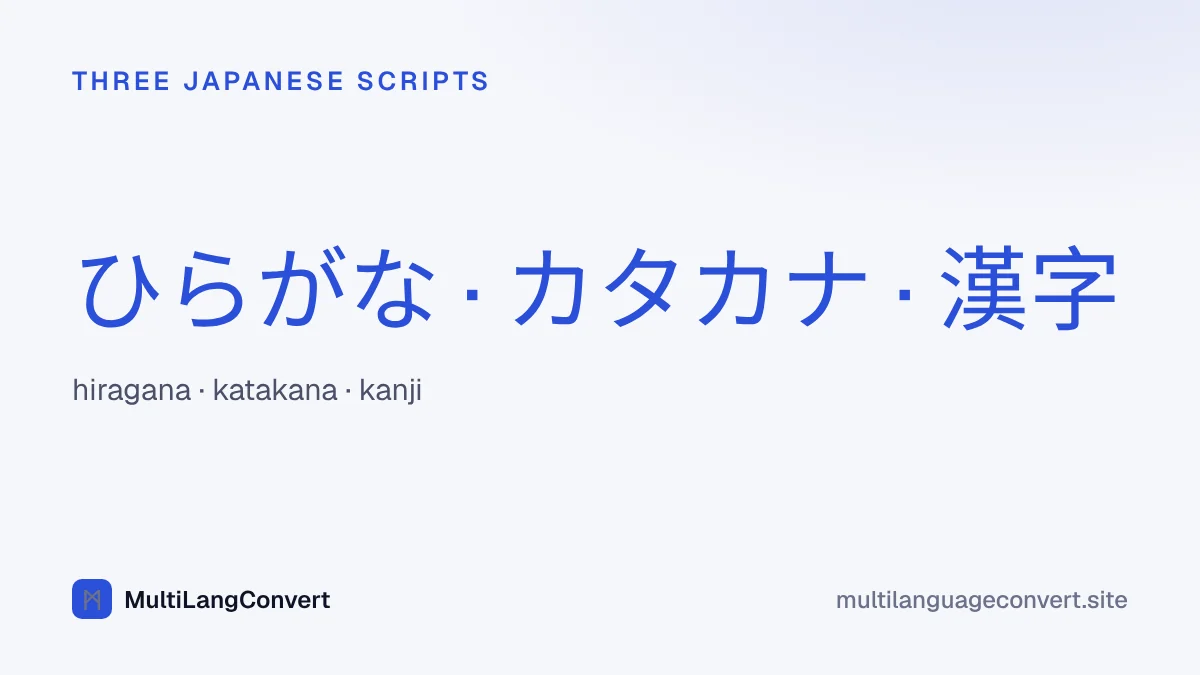
The three scripts at a glance
| Hiragana | Katakana | Kanji | |
|---|---|---|---|
| Example | ひらがな | カタカナ | 漢字 |
| Type | Syllabary (46 basic) | Syllabary (46 basic) | Logographic (thousands) |
| Look | Rounded, flowing | Angular, simple strokes | Complex, many strokes |
| Main use | Grammar endings, particles, native words | Foreign words, names, emphasis, sound effects | Nouns, verb and adjective stems, names |
| Learned | First, in early childhood | Soon after hiragana | Throughout school (2,136 jōyō kanji) |
How they mix in a sentence
Look at this ordinary sentence:
私はコーヒーを飲みます。 (watashi wa kōhī o nomimasu, “I drink coffee.”)
- 私 (watashi, “I”) is kanji: it carries the meaning.
- は (wa) and を (o) are hiragana particles that mark the topic and the object.
- コーヒー (kōhī, “coffee”) is katakana because it is a loanword, from Dutch koffie.
- 飲みます mixes a kanji stem (飲, “drink”) with hiragana endings (みます) that show politeness and tense. Hiragana used like this is called okurigana.
Because the scripts switch at word boundaries, Japanese can be read without spaces. The change from kanji to hiragana often tells you where a word ends.
Where hiragana and katakana came from
Both developed in the 9th century from kanji used purely for their sounds. Hiragana grew out of cursive brush forms of whole characters: あ comes from 安, い from 以. It was associated with poetry and private writing and was used by women writers of the Heian court; The Tale of Genji, written by Murasaki Shikibu around 1000, is largely in hiragana. Katakana came from fragments of characters, written by Buddhist monks as reading aids in the margins of Chinese texts: カ is the left part of 加, イ the left part of 伊.
When to use katakana
- Loanwords: テレビ (terebi, television), パン (pan, bread, from Portuguese).
- Foreign names and places: ロンドン (Rondon, London), アリ (Ari, Ali).
- Sound effects and onomatopoeia, especially in manga: ドキドキ (dokidoki, a pounding heart).
- Emphasis, the way English uses italics or capitals.
- Scientific names of animals and plants, such as ネコ for “cat” in biology texts.
Katakana also has extra combinations to write foreign sounds that Japanese lacks, such as ティ (ti), ファ (fa) and ウィ (wi), and uses a long dash, ー, for long vowels. Our Katakana Converter handles these for you.
When to use hiragana
- Particles: は, が, を, に, で, と.
- Verb and adjective endings: 食べる, 高い.
- Native words with no common kanji, or whose kanji are rare: これ (kore, this), とても (totemo, very).
- Furigana: small hiragana printed above kanji to show the reading, common in children’s books and for unusual names.
- Text for young children and beginners, written entirely in hiragana with spaces.
Practise reading and writing it with our Hiragana Translator.
Romaji: the fourth script
Japanese written in Latin letters is called romaji. It is used for signs, passports, typing and teaching. There are two main systems: Hepburn (shi, chi, tsu, fu), which is closer to English pronunciation and used in most textbooks and on signs, and Kunrei-shiki (si, ti, tu, hu), the government’s official system, which follows the structure of the kana chart. Most Japanese computers and phones are typed in romaji, which the keyboard software turns into kana and then kanji.
Which should you learn first?
Start with hiragana. It is needed for grammar in every sentence and is the basis for reading furigana. Most learners can learn all 46 basic characters in one to two weeks with daily practice. Learn katakana next, because so much modern vocabulary, from コンピューター (computer) to スマホ (smartphone), is written in it. Begin kanji alongside, starting with common ones such as 日 (day, sun), 人 (person) and 大 (big).
| Sound | Hiragana | Katakana | Kanji source of hiragana |
|---|---|---|---|
| a | あ | ア | 安 |
| i | い | イ | 以 |
| ka | か | カ | 加 |
| ri | り | リ | 利 |
| n | ん | ン | 无 |
Common mistakes when mixing scripts
Learners often write a loanword in hiragana or a grammar ending in katakana. Neither is wrong in a strict sense, but it looks odd to a Japanese reader, like writing an English sentence with random words in capitals. Another common slip is to forget the long-vowel mark in katakana: ビル (biru) is “building”, while ビール (bīru) is “beer”. The small っ matters just as much: キテ and キッテ are different words. Our converters show both scripts side by side, which helps you spot these differences.
Some pairs, such as か/カ and り/リ, look alike because they come from the same kanji. Spotting these pairs makes katakana quicker to learn once you know hiragana.
Sources
- The Unicode Consortium, Hiragana code chart
- The Unicode Consortium, Katakana code chart
- Agency for Cultural Affairs, Government of Japan, bunka.go.jp, official guidance on kana and loanword notation.
- Timothy J. Vance, The Sounds of Japanese (Cambridge University Press, 2008).