Viking Words in English: What We Borrowed from Old Norse
English borrowed hundreds of everyday words from Old Norse, the language of the Viking settlers who lived in northern and eastern England from the late 9th century. They include the pronouns they, them and their, verbs such as take, give (in its modern form), get and die, and nouns such as sky, egg, knife, window and law.
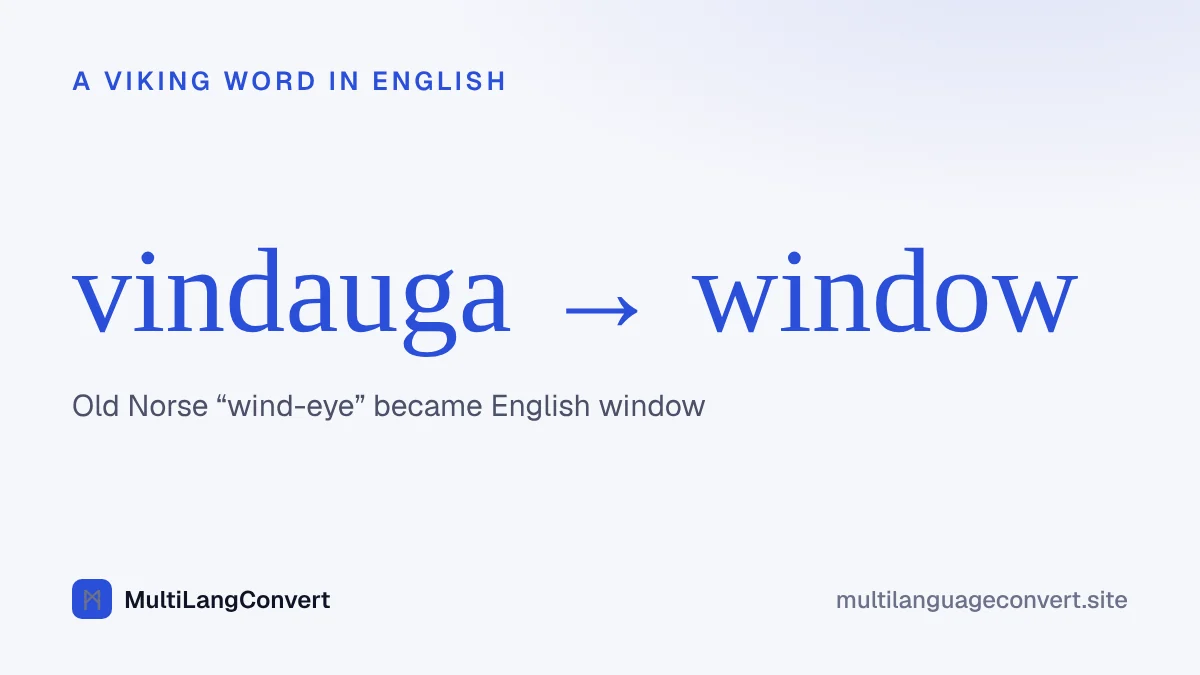
How Norse words got into English
From 865, a large Viking army campaigned in England, and Scandinavians settled across the north and east, in the area later called the Danelaw. Old English and Old Norse were related Germanic languages. Speakers could probably understand each other in a basic way, much as Danes and Norwegians can today. Over generations of living side by side and marrying, the two languages blended. Norse words came in for everyday things, not only for war or trade, which tells us the contact was close and long-lasting.
Everyday words from Old Norse
| English | Old Norse | Replaced or joined Old English |
|---|---|---|
| they, them, their | þeir, þeim, þeira | hīe, him, hiera |
| sky | ský (“cloud”) | heofon (now “heaven”) |
| egg | egg | ǣg (plural ǣgru) |
| window | vindauga (“wind-eye”) | ēagþyrel (“eye-hole”) |
| take | taka | niman |
| die | deyja | steorfan (now “starve”) |
| law | lǫg | ǣ |
| husband | húsbóndi (“house-dweller”) | wer |
| knife | knífr | seax |
| skin | skinn | hȳd (now “hide”) |
| ill | illr | yfel (now “evil”) |
| call | kalla | clipian |
| anger | angr (“grief”) | — |
| ugly | uggligr (“dreadful”) | — |
| happy | happ (“luck”) + -y | blīþe (now “blithe”) |
Look up the Norse forms with our Old Norse Translator and the Old English ones with the Old English Translator.
Pairs that survived side by side
Sometimes English kept both words and gave them different jobs:
| From Old English | From Old Norse |
|---|---|
| shirt | skirt |
| shatter | scatter |
| no | nay |
| whole | hale |
| rear (bring up) | raise |
| church | kirk (Scots and northern English) |
Shirt and skirt both come from one Germanic word meaning “short garment”. The Old English form had a soft sh sound, while the Norse form kept a hard sk.
A quick test: sk- words
In Old English, the sound sk had changed to sh (Old English sc, as in scip, “ship”). Old Norse kept the sk. So many English words beginning with sk came from Norse: sky, skin, skill, skull, skirt, ski (much later, via Norwegian). It is a handy rule of thumb, though not every sk- word is Norse.
Place names and personal names
The Danelaw is full of Norse place names:
- -by (Norse bœr, farm or village): Whitby, Derby, Grimsby, Selby.
- -thorpe (secondary settlement): Scunthorpe, Cleethorpes.
- -thwaite (clearing): Braithwaite, Bassenthwaite.
- -toft (homestead): Lowestoft.
- fell (Norse fjall, mountain) and beck (bekkr, stream) in the Lake District and Yorkshire.
Surnames ending in -son, such as Johnson and Dawson, follow a Norse pattern (-son, “son of”) that was especially common in the north of England.
Grammar, not just words
Some linguists argue that contact with Norse also helped simplify English grammar. Old English and Old Norse shared many word stems but had different endings. In a mixed community, the endings were the hardest part to get right and the easiest to drop, while word order did the job instead. Whether Norse caused this or only sped it up is debated, but English did lose most of its case endings between about 1000 and 1300.
Words from the sea and the law
The Vikings were seafarers and traders, and some of their words reflect that, though fewer than you might expect. English “keel” may come from Norse kjǫlr, and “steersman” has a Norse cousin in stýrimaðr. The Danelaw also had its own legal customs, and Norse gave English “law” itself, along with “by-law” (from býlǫg, “village law”) and “outlaw” (útlagi, a man placed outside the law). An outlaw in the Norse world could be killed without penalty, which made outlawry one of the harshest sentences an assembly could pass.
Norse words that did not last
Not every borrowing survived. Middle English texts from the north use Norse words such as gate for “road” (from gata), which survives today only in street names: Briggate in Leeds, Micklegate and Coppergate in York. “Gate” in these names has nothing to do with a gate in a wall. Similarly, til (“to”) survives as “till” and “until”, and fro (“from”) lives on only in “to and fro”. Words like these are a reminder that the Danelaw dialects once had far more Norse in them than standard English does today.
Write them in runes
If you want an authentic Viking-age look for one of these words, find the Old Norse form, then write it with the Younger Futhark Translator. For example, vindauga becomes ᚢᛁᚾᛏᛅᚢᚴᛅ: v as ᚢ, d as ᛏ and g as ᚴ, as Viking carvers wrote them.
Sources
- Encyclopaedia Britannica, “Old Norse language“.
- Encyclopaedia Britannica, “Old English language“.
- University of Copenhagen, A Dictionary of Old Norse Prose
- Oxford English Dictionary, etymologies of sky, window and they.