Attic vs Koine Greek: Which Ancient Greek Should You Use?
You want a motto, a tattoo or a line for a book in Ancient Greek, and the first question any expert will ask is: which Ancient Greek? The Greek of Plato’s Athens and the Greek of the New Testament are separated by about 400 years, and the differences matter.
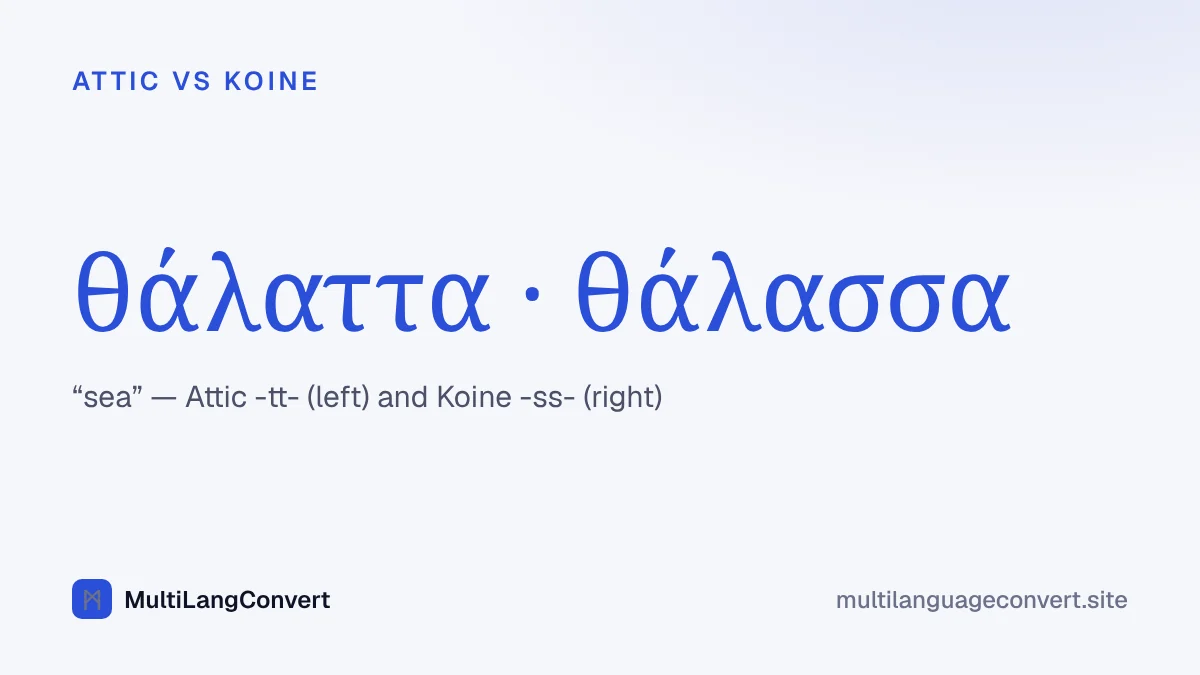
The short answer: Attic Greek is the dialect of classical Athens in the 5th and 4th centuries BC, used by Plato, Sophocles and Thucydides, and it is what most university courses teach. Koine Greek is the “common” Greek that grew out of Attic after Alexander the Great, spoken across the eastern Mediterranean and used for the New Testament and the Septuagint. For classical, philosophical or literary text, choose Attic. For Christian or biblical text, choose Koine.
What is Attic Greek?
Attic is the dialect of Attica, the region around Athens. Encyclopaedia Britannica describes it as the most prestigious dialect of Classical Greek, because Athens was the cultural centre of the Greek world in the 5th and 4th centuries BC.
Almost every classical author students read wrote in Attic or a literary form close to it: the tragedians Aeschylus, Sophocles and Euripides, the historian Thucydides, the orator Demosthenes and the philosopher Plato. That is why “Ancient Greek” in a textbook or university course nearly always means Attic.
Attic is known for a few distinctive features. It writes -tt- where most other dialects have -ss-, as in thalatta (sea) for thalassa. It keeps the dual number for pairs, and it uses the optative mood freely for wishes and possibilities.
What is Koine Greek?
Koine (κοινή, “common”) is the shared form of Greek that spread after Alexander the Great’s conquests in the 330s and 320s BC. According to Britannica, it was based chiefly on Attic, was used from the 4th century BC to about the 6th century AD, and by the 2nd century AD had superseded the other ancient Greek dialects across Greece, Egypt and the Near East.
Koine was the language of trade, administration and, eventually, early Christianity. The Septuagint, the Greek translation of the Hebrew Bible made in Alexandria from the 3rd century BC, and the entire New Testament are written in Koine.
It is simpler than Attic in several ways. The dual disappeared, the optative became rare, and many irregular forms were levelled. Writers also used more prepositions and fewer particles, so sentences read more directly.
Attic vs Koine Greek: key differences
| Feature | Attic Greek | Koine Greek |
|---|---|---|
| Period | c. 500–300 BC | c. 300 BC–AD 300 |
| Where | Athens and Attica | The whole Hellenistic world, Egypt to Syria |
| Typical authors | Plato, Sophocles, Thucydides | New Testament writers, Polybius, Epictetus |
| “Sea” | θάλαττα (thalatta) | θάλασσα (thalassa) |
| Dual number | Used for pairs | Lost |
| Optative mood | Common | Rare |
| Style | Many particles, complex sentences | Plainer, more prepositions |
| Pronunciation | Pitch accent, distinct vowels | Shift toward stress accent; vowels start to merge |
The same idea in both
Take the famous line from John 1:1, “In the beginning was the Word.” In Koine it is Ἐν ἀρχῇ ἦν ὁ λόγος (En archē ēn ho logos). The same words would be perfectly good Attic too. That’s the point: Koine and Attic share most of their vocabulary and grammar, so a reader of one can read the other with some adjustment.
The differences show in longer passages: Attic writers pile up particles like μέν and δέ, use the optative in indirect speech, and prefer the -tt- spellings.
Which Ancient Greek should you translate into?
Match the dialect to the meaning of your text. These are the choices most people face.
- A philosophical motto (from Socrates, Plato, the Stoics): Attic. “Know thyself”, γνῶθι σεαυτόν (gnōthi seauton), is the classic example.
- A Bible verse or Christian phrase: Koine, the language the New Testament was written in.
- A mythological name or epic line: Homeric Greek, an older poetic mix of Ionic and Aeolic forms, is the authentic choice; Attic is acceptable.
- A modern phrase for a tattoo or logo: Attic is the safest default, because it is the standard taught and checked by classicists.
Our Ancient Greek Translator translates into Attic-style Classical Greek with polytonic accents and a Latin-letter transliteration, so you can see and hear how the result reads.
How do you write English in Ancient Greek letters?
Translation and transliteration are different. Translating changes the words into Greek; transliterating just spells English sounds in the Greek alphabet.
| Approach | “Sophia” (a name) | “Wisdom” (a word) |
|---|---|---|
| Transliteration | Σοφία | Ουισδομ (meaningless in Greek) |
| Translation | — | σοφία (sophia) |
For names, transliterate. For words and mottos, translate. Mixing the two is the most common error on tattoos.
Polytonic accents: why the marks matter
Ancient Greek is properly written in the polytonic system, with three accents (acute ´, grave `, circumflex ˜) and two breathings over initial vowels (rough ῾ for an h-sound, smooth ᾿ for none). Modern Greek has used a single accent since 1982.
The marks are part of the spelling. ὅς (hos, “who”) and ὡς (hōs, “as”) differ only by the vowel and accent. A text with missing or modern accents is a red flag for anyone who reads Ancient Greek.
Where can you check an Ancient Greek translation?
Classicists rely on a handful of free, authoritative tools.
- Logeion (University of Chicago) – searches the standard dictionary, Liddell–Scott–Jones (LSJ), and others at once.
- Perseus Digital Library (Tufts University) – Greek texts with translations and a word-by-word parser.
- Thesaurus Linguae Graecae (University of California, Irvine) – the largest corpus of Greek literature, used to check how real authors used a word.
A good test: look up every word in Logeion, and confirm the dictionary gives examples from Attic authors (for a classical motto) or the New Testament (for a biblical one).
Common mistakes with Ancient Greek translations
- Using Modern Greek. Online translators that offer only “Greek” give Modern Greek, which differs in grammar, vocabulary and accents.
- Dropping the breathing marks. They show whether a word starts with an h-sound.
- Wrong case for the role. “Love conquers” needs ἔρως in the nominative; on its own, a word’s case should match its use.
- Mixing dialects. A Koine word with Attic spelling, or the reverse, looks careless to an expert.
- Translating idioms word by word. “Carpe diem” is Latin; a word-for-word Greek version doesn’t carry the same sense.
Greek wasn’t the only language of the ancient Near East with a split between classical and everyday forms. Aramaic, the everyday language of Jesus, had a similar story, explained in our guide to translating English to Aramaic.
Putting it together
Attic is the Greek of classical Athens: precise, rich in particles and the standard of every Greek course. Koine is its simpler descendant, the common tongue of the Hellenistic world and the language of the New Testament.
Choose Attic for philosophy, literature and most mottos; choose Koine for biblical text. Then check each word in Logeion, keep every accent and breathing mark, and transliterate names rather than translating them.
Sources
- Encyclopaedia Britannica, “Attic dialect” and “Koine Greek language“.
- University of Chicago, Logeion (LSJ and other lexica).
- Tufts University, Perseus Digital Library.
- University of California, Irvine, Thesaurus Linguae Graecae.
- Herbert Weir Smyth, Greek Grammar (rev. Gordon M. Messing, Harvard University Press, 1956), on dialects, the dual and the optative.
- Geoffrey Horrocks, Greek: A History of the Language and Its Speakers (2nd ed., Wiley-Blackwell, 2010), chapters on Koine.