How to Translate English to Aramaic: Dialects and Scripts
Aramaic is the language Jesus most likely spoke, the language of parts of the books of Daniel and Ezra, and a language still spoken today by Assyrian, Chaldean and Syriac Christian communities. That long history is exactly why “translate English to Aramaic” has no single answer.
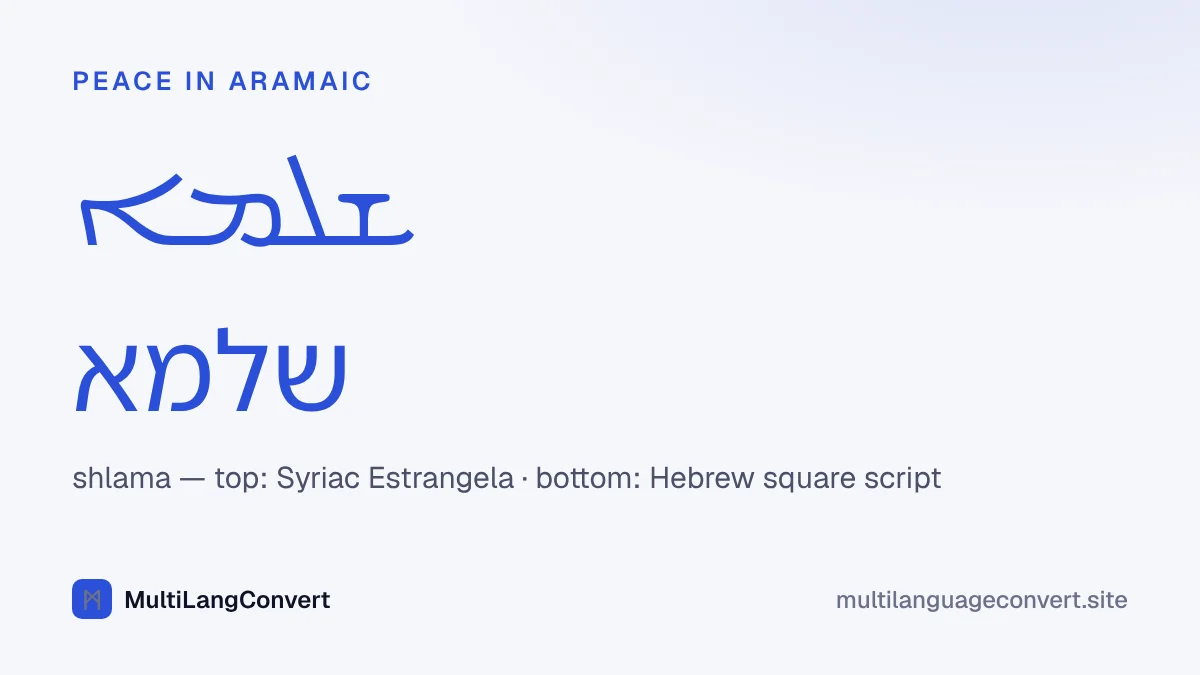
The short answer: to translate English into Aramaic, first choose the dialect and script. For a phrase connected to Jesus or the early church, the usual choice is Syriac or a Galilean-style Jewish Palestinian Aramaic, written in Syriac or Hebrew square letters. For a biblical feel, use Biblical Aramaic in square script. Then translate word by word from a scholarly lexicon and check the grammar, because Aramaic marks gender and uses a different word order from English.
What is Aramaic?
Aramaic is a Northwest Semitic language, closely related to Hebrew and more distantly to Arabic. According to Encyclopaedia Britannica, it is thought to have first appeared among the Aramaeans about the late 11th century BC, in what is now Syria.
It became an international language when the Assyrian, then Babylonian and Persian empires used it for administration. Under the Persian Achaemenid Empire, Imperial Aramaic was written from Egypt to Afghanistan. Hebrew square letters, Syriac script and even the Arabic and Mongolian scripts descend from Aramaic writing.
Which Aramaic dialect should you use?
Aramaic changed over almost 3,000 years, so the right dialect depends on your purpose.
| Dialect | Period | Used for | Script |
|---|---|---|---|
| Imperial (Official) Aramaic | c. 700–300 BC | Persian Empire administration | Aramaic square script |
| Biblical Aramaic | c. 500–150 BC | Parts of Daniel and Ezra | Hebrew square script |
| Jewish Palestinian (Galilean) | c. 200 BC–AD 700 | Everyday speech of Judea and Galilee; Jerusalem Talmud | Hebrew square script |
| Syriac (Classical) | c. AD 200–1300+ | Peshitta Bible, Christian literature; still liturgical | Syriac (Estrangela, Serto, East Syriac) |
| Jewish Babylonian | c. AD 200–1200 | Babylonian Talmud | Hebrew square script |
| Neo-Aramaic | Modern | Spoken today (Assyrian, Chaldean, Turoyo, Western Neo-Aramaic) | Syriac or Latin |
Britannica’s entries on East Aramaic and West Aramaic explain how these branches divide.
What language did Jesus speak?
Most historians agree Jesus spoke a Galilean dialect of Aramaic in daily life, probably knew Hebrew for scripture and may have known some Greek. The Gospels, written in Greek, preserve a few of his Aramaic words.
| Gospel phrase | Meaning | Where |
|---|---|---|
| Talitha koum | “Little girl, arise” | Mark 5:41 |
| Ephphatha | “Be opened” | Mark 7:34 |
| Abba | “Father” | Mark 14:36 |
| Eloi, Eloi, lema sabachthani? | “My God, my God, why have you forsaken me?” | Mark 15:34 |
| Maranatha | “Our Lord, come” | 1 Corinthians 16:22 |
No text survives in Jesus’ exact dialect. The closest written evidence comes from Jewish Palestinian Aramaic texts and from Syriac, which is why translators choose one of those two.
How to translate English to Aramaic, step by step
- Pick the dialect from the table above, based on whether your text is biblical, Christian, Jewish or modern.
- Pick the script. Hebrew square letters for Biblical and Jewish Aramaic; Syriac Estrangela for Classical Syriac.
- Translate the core words using a scholarly lexicon. The Comprehensive Aramaic Lexicon at Hebrew Union College covers every period of the language.
- Apply the grammar. Verbs change for gender (you said to a man vs a woman), nouns take a “definite” ending -ā instead of a word for “the”, and possessives attach to the noun.
- Write right to left, keeping each letter’s correct joining form if you use Syriac.
- Check a parallel text. If your phrase appears in the Bible, compare the Peshitta (Syriac) or Targum (Jewish Aramaic) version.
Our Aramaic Translator follows this approach: it translates from an Aramaic dictionary with grammar rules, writes the result in Hebrew square or Syriac script, and shows a pronunciation line.
Example: “my father”
In Aramaic, “my” attaches to the end of the noun. “Father” is ʾab or ʾabbā, so “my father” is ʾabbā or ʾabī, depending on dialect: in Syriac ܐܒܝ, in square script אבי. The word Abba in Mark 14:36 is this same word, used as a direct, affectionate address.
Aramaic scripts compared
| Script | “Peace” (shlama / shlām) | Notes |
|---|---|---|
| Hebrew square | שלמא | Used for Biblical and Jewish Aramaic |
| Syriac Estrangela | ܫܠܡܐ | The classical Syriac form, common for tattoos |
Both scripts write right to left and mostly record consonants. Vowels are added with optional dots or marks, so the same word can look shorter than its pronunciation.
Is Aramaic still spoken?
Yes. Neo-Aramaic languages are spoken by Assyrian, Chaldean and Syriac communities from northern Iraq, southeast Turkey, northeast Syria and Iran, and by large diaspora communities in the United States, Sweden, Germany and Australia. Western Neo-Aramaic survives in the village of Maaloula and nearby villages in Syria.
Most Neo-Aramaic varieties are considered endangered, and modern speakers often differ from classical forms in vocabulary and pronunciation. For a phrase meant for a modern Assyrian or Chaldean family, ask a speaker of that community’s dialect.
Common mistakes with English-to-Aramaic translations
- Using Hebrew instead of Aramaic. They share a script and many roots, but grammar and many words differ.
- Ignoring gender. “I love you” said to a woman differs from the same phrase said to a man.
- Breaking Syriac letters apart. Syriac letters join like Arabic; isolated letters look wrong to readers.
- Flipping the text. Some tattoo designs mirror right-to-left text by mistake; check the first letter is on the right.
- Mixing dialects. A Syriac word in square script with Biblical spelling confuses readers of both.
For another ancient language that splits into classical and everyday forms, see Attic vs Koine Greek.
Putting it together
Aramaic isn’t one language but a family of dialects spanning 3,000 years. Choose the dialect that matches your purpose, pick the right script, translate from a scholarly lexicon such as the Comprehensive Aramaic Lexicon, and mind gender and possessive endings.
For a Jesus-related phrase, Syriac or Jewish Palestinian Aramaic is the most faithful choice. For anything permanent, have a reader of that dialect confirm the result.
Sources
- Encyclopaedia Britannica, “Aramaic language“, “East Aramaic” and “West Aramaic“.
- Hebrew Union College, Comprehensive Aramaic Lexicon.
- The Gospel of Mark 5:41, 7:34, 14:36, 15:34; 1 Corinthians 16:22.
- Holger Gzella, A Cultural History of Aramaic (Brill, 2015).
- Theodore H. Robinson, Paradigms and Exercises in Syriac Grammar (4th ed., Oxford University Press, 1962).
- Geoffrey Khan, The Neo-Aramaic Dialect of Barwar (Brill, 2008), on a modern spoken dialect.