Cajun French vs Louisiana Creole: What’s the Difference?
In south Louisiana, you might hear “Comment ça va, cher?” from one grandparent and “Ki jan to yé?” from another. Both are “How are you?”, and both are local, but they’re two different languages: Cajun French and Louisiana Creole.
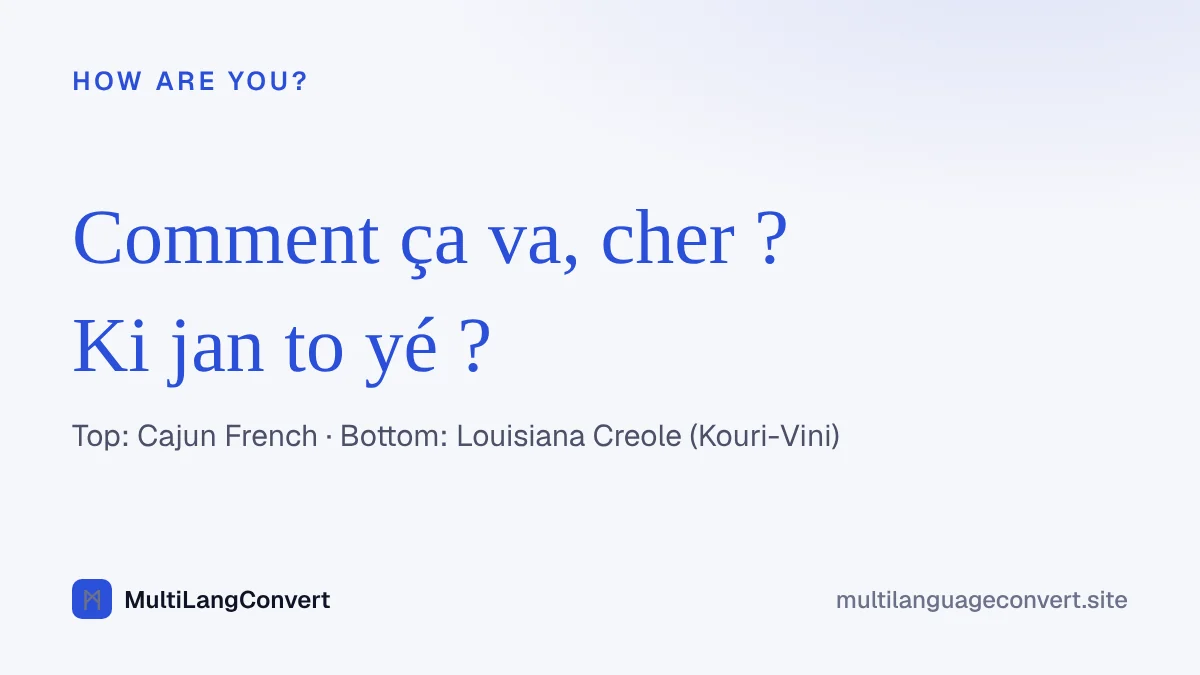
The short answer: Cajun French (part of Louisiana French) is a dialect of French, descended mainly from the French of the Acadians and other colonists, so a speaker from France or Quebec can largely follow it. Louisiana Creole (Kouri-Vini) is a separate creole language: most of its words come from French, but its grammar is its own, so French speakers find it much harder. CODOFIL, the state’s Council for the Development of French in Louisiana, describes them exactly this way.
What is Cajun French?
Cajun French is the variety of Louisiana French spoken by the Cajuns, descendants of the Acadians. The Acadians were French settlers in what is now Nova Scotia and New Brunswick, expelled by the British from 1755 in the “Grand Dérangement”. Many reached Louisiana from the 1760s and settled along the bayous and prairies west of New Orleans.
Their French mixed with the French of earlier colonists, Spanish, Native American languages, African languages and, later, English. Linguists today often use the wider term Louisiana French, because Cajuns, Creoles and others all spoke it.
CODOFIL notes that French was a dominant language in Louisiana when the territory was sold to the United States in 1803, and that it lost ground in schools and public life after the Civil War, becoming mostly a home and community language by the mid-20th century.
What is Louisiana Creole (Kouri-Vini)?
Louisiana Creole developed in the 18th and 19th centuries from contact between French colonists, enslaved Africans and Native peoples. According to the Louisiana Creole Dictionary, it’s distinct from both Louisiana French and Haitian Creole, its spelling isn’t standardised, and it’s classified as critically endangered, with estimates of a few hundred to a few thousand fluent speakers.
The name Kouri-Vini (“ran-came”, from a common verb pair) is used by many revitalisation groups to give the language a name of its own, separate from “Creole” as an ethnic or cultural label.
Cajun French vs Louisiana Creole: key differences
| Feature | Cajun / Louisiana French | Louisiana Creole |
|---|---|---|
| Type | Dialect of French | French-based creole language |
| Understood by French speakers? | Mostly | With difficulty |
| “I” | je / moi | mo |
| “you” | tu / vous | to (one person) / vouzòt (plural) |
| “he / she” | il / elle | li |
| Verbs | Conjugated (je mange, il mange) | Fixed form plus markers (mo manjé, li manjé) |
| Past | j’ai mangé | mo té manjé |
| Ongoing action | je suis après manger | mo apé manjé |
| Future | je vas manger | mo sa manjé / mo va manjé |
| “I don’t know” | je connais pas | mo pa konnin |
The biggest difference is in the verbs. French changes the ending for each person; Creole keeps one form and adds small words before it to show time, much like Haitian Creole.
Shared words, different spellings
The two languages share a lot of local vocabulary. CODOFIL’s example is “raccoon”: un raton laveur in standard French, un chaoui in Louisiana French and in shawi in Creole, pronounced the same and spelled differently.
How is Cajun French different from standard French?
- Older words survive. Cajuns say asteur (“now”, from à cette heure) where France says maintenant.
- Local words for local things. Ouaouaron (bullfrog), chaoui (raccoon), bayou.
- English borrowings. Le truck, le bus and verbs like checker appear in everyday speech.
- Different grammar habits. Je suis après travailler means “I’m working”; standard French uses je suis en train de travailler.
- Terms of affection. Cher (pronounced “sha”) is used for anyone you’re fond of.
Common Cajun French phrases
| Phrase | Meaning |
|---|---|
| Comment ça va, cher? | How are you, dear? |
| Ça c’est bon! | That’s good! |
| Lâche pas la patate | Don’t give up (literally “don’t drop the potato”) |
| Mais, là! | Well, now! (surprise) |
| Fais dodo | Go to sleep; also a Cajun dance party |
| Laissez les bons temps rouler | Let the good times roll (an English calque, popular for festivals) |
Our Cajun French Translator translates English into Cajun French using local words like these, with notes where Cajun and standard French differ.
Which should you use?
- For Cajun family, food, music or festival text: Cajun French.
- For a Creole family heritage or Kouri-Vini revitalisation: Louisiana Creole, checked against the Louisiana Creole Dictionary.
- For signs or anything official in Louisiana: standard French is legally recognised; CODOFIL notes that Louisiana law treats French-language acts as equally valid.
Are Cajun French and Louisiana Creole dying?
Both are endangered, but both have active revival movements. Louisiana runs French immersion schools in public school districts, and CODOFIL supports teachers and programmes. Kouri-Vini has online courses, a growing community dictionary and the textbook Ti Liv Kréyòl (2nd ed., 2020).
Language revival in Louisiana mirrors other heritage-language efforts in the United States, such as the push to keep Navajo words and phrases in daily use.
Putting it together
Cajun French is a dialect of French with old, local and English-influenced words; Louisiana Creole is a separate creole language with French vocabulary and its own grammar. Listen for je vs mo, and conjugated verbs vs markers like té and apé, and you’ll know which one you’re hearing.
Sources
- CODOFIL (Council for the Development of French in Louisiana), “Louisiana French and Creole“.
- Louisiana Creole Dictionary, About page.
- Albert Valdman et al., Dictionary of Louisiana French: As Spoken in Cajun, Creole, and American Indian Communities (University Press of Mississippi, 2010).
- Albert Valdman et al., Dictionary of Louisiana Creole (Indiana University Press, 1998).
- Guillory-Chatman, Mayeux, Wendte and Wiltz, Ti Liv Kréyòl (2nd ed., 2020).
- Carl A. Brasseaux, The Founding of New Acadia (Louisiana State University Press, 1987).