What Makes Puerto Rican Spanish Different? 25 Words Explained
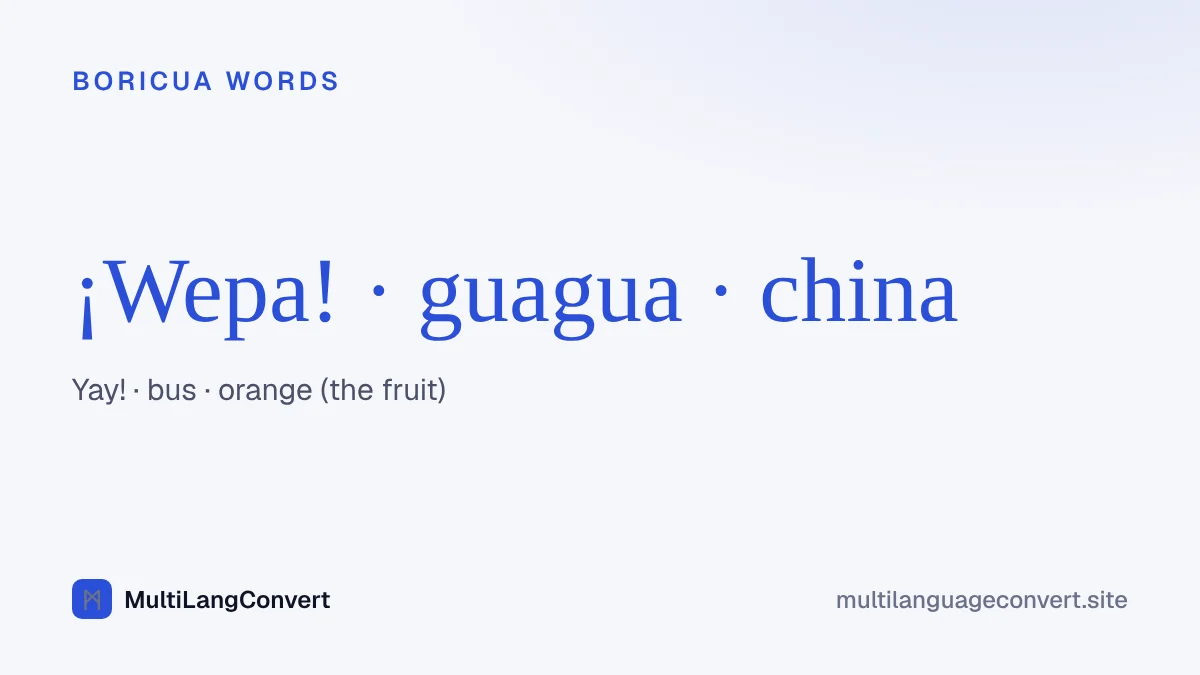
Ask for an orange in San Juan and you might say una china. Wait for the bus and you’re waiting for la guagua. Throw something away and it goes in the zafacón. Puerto Rican Spanish is fully Spanish, but it has its own sound, its own slang and words you won’t hear in Madrid or Mexico City.
The short answer: Puerto Rican Spanish is a Caribbean variety of Spanish. It’s known for softening or dropping the s at the end of syllables, sometimes turning r into l (Puelto Rico), and for vocabulary from Taíno, African languages and English. Most of its grammar is standard Spanish, so the differences are mainly in pronunciation and everyday words.
What makes Puerto Rican Spanish different?
Puerto Rican Spanish belongs to the Caribbean family, along with Cuban and Dominican Spanish. Its features come from the island’s history: the Spanish of Andalusia and the Canary Islands, the Taíno people who lived there before 1493, enslaved Africans brought in the colonial period, and, since 1898, close contact with American English.
Spanish and English are both official languages in Puerto Rico, but Spanish is the main language of daily life. The Academia Puertorriqueña de la Lengua Española, a member of the Association of Academies of the Spanish Language, documents and studies the island’s vocabulary.
How does Puerto Rican Spanish sound?
| Feature | Standard spelling | Often sounds like |
|---|---|---|
| Final s softened to h or dropped | los amigos, esto | loh amigo, ehto |
| r at the end of a syllable becomes l | Puerto Rico, comer | Puelto Rico, comel |
| -ado becomes -ao | cansado, pescado | cansao, pescao |
| Double rr pronounced at the back of the mouth | carro, perro | a rasping “kh”-like sound in some speakers |
| para shortened | para allá | pa’llá |
These features vary by speaker, region and formality. The r-to-l change, which linguists call lambdacism, is more common in casual speech and is also heard in parts of the Dominican Republic and Andalusia.
25 Puerto Rican Spanish words and what they mean
| Word or phrase | Meaning | Elsewhere you’d say |
|---|---|---|
| boricua | Puerto Rican (from Taíno Borikén) | puertorriqueño |
| ¡Wepa! | Yay! / Woo-hoo! | ¡Bravo! |
| chévere | great, cool | genial |
| pana | friend, buddy | amigo |
| corillo | group of friends | grupo de amigos |
| janguear | to hang out (from English) | salir, pasar el rato |
| guagua | bus | autobús |
| china | orange (the fruit) | naranja |
| zafacón | trash can | basurero, papelera |
| chavos | money, cash | dinero |
| mahones | jeans | vaqueros |
| bregar | to deal with, handle | manejar |
| al garete | out of control, adrift | sin control |
| ¿Qué es la que hay? | What’s up? | ¿Qué pasa? |
| ¡Ay bendito! | Oh dear! (sympathy or frustration) | ¡Ay, Dios mío! |
| averiguao | nosy person | chismoso |
| jíbaro | rural highlander; country person | campesino |
| chinchorro | small roadside bar | bar pequeño |
| jurutungo | a very remote place, “the middle of nowhere” | lugar lejano |
| perreo | reggaeton dancing | — |
| coquí | the island’s tiny tree frog, a national symbol | — |
| mano / manito | bro (from hermano) | hermano |
| ahorita | in a while (not necessarily “right now”) | dentro de un rato |
| brutal | awesome | increíble |
| gufear | to joke around (from English “goof”) | bromear |
Some of these are now official. In its 2023 update, the Real Academia Española added perreo, jurutungo and güira to its dictionary, as reported by Metro Puerto Rico.
Where do Puerto Rican words come from?
- Taíno: words for local life, like hamaca (hammock), huracán (hurricane), canoa and Borikén, the Taíno name for the island. Several entered English through Spanish.
- African languages: words linked to food and music, such as mofongo and the drum rhythm bomba.
- English: since 1898, words like janguear, parquear (to park) and el break.
- Old and regional Spanish: words from Andalusia and the Canary Islands, such as guagua, shared with Cuba and the Canaries.
How do you translate English into Puerto Rican Spanish?
- Start with correct standard Spanish grammar. Verb forms and agreement are the same as anywhere.
- Swap in island words for everyday things: guagua, china, zafacón, chavos.
- Choose an informal tone for friends: tú, not usted, and slang like pana and chévere.
- Keep spelling standard in writing. Write Puerto Rico and cansado, even if you’d say Puelto Rico and cansao, unless you’re quoting speech.
Our Puerto Rican Spanish Translator translates English into casual Puerto Rican Spanish using island vocabulary, and notes the standard Spanish equivalent where it differs.
Common mistakes
- Using Mexican or Spain slang. Güey (Mexico) or vale (Spain) sound out of place in San Juan.
- Overdoing the slang. Real speakers mix island words into ordinary Spanish; they don’t use five slang words a sentence.
- Writing the accent everywhere. Spelling dropped s’s in formal text looks like mockery.
- Assuming “Spanglish” means poor Spanish. Code-switching is a normal, skilled feature of bilingual speech.
Puerto Rico’s language story echoes Louisiana’s, where French survived alongside English; see Cajun French vs Louisiana Creole.
Putting it together
Puerto Rican Spanish is Caribbean Spanish with a soft s, a sometimes-l for r, and a vocabulary shaped by Taíno, African, Andalusian and English influences. Use standard Spanish grammar, add island words like guagua, china and pana, and keep the tone friendly. ¡Wepa!
Sources
- Academia Puertorriqueña de la Lengua Española.
- Metro Puerto Rico, “La RAE incluye perreo, jurutungo y güira” (28 November 2023).
- Real Academia Española, Diccionario de la lengua española.
- Asociación de Academias de la Lengua Española, Diccionario de americanismos (2010).
- John M. Lipski, Latin American Spanish (Longman, 1994), chapter on Puerto Rico.
- Humberto López Morales, Estratificación social del español de San Juan de Puerto Rico (UNAM, 1983).