How to Write English Words in Hiragana: A Simple Guide
Type “Emma” into a converter and you’ll get えま. Type “Michael” and you’ll get まいける. Both are correct hiragana, but a Japanese reader would normally write them in katakana, as エマ and マイケル. Knowing why is the key to writing English in hiragana well.
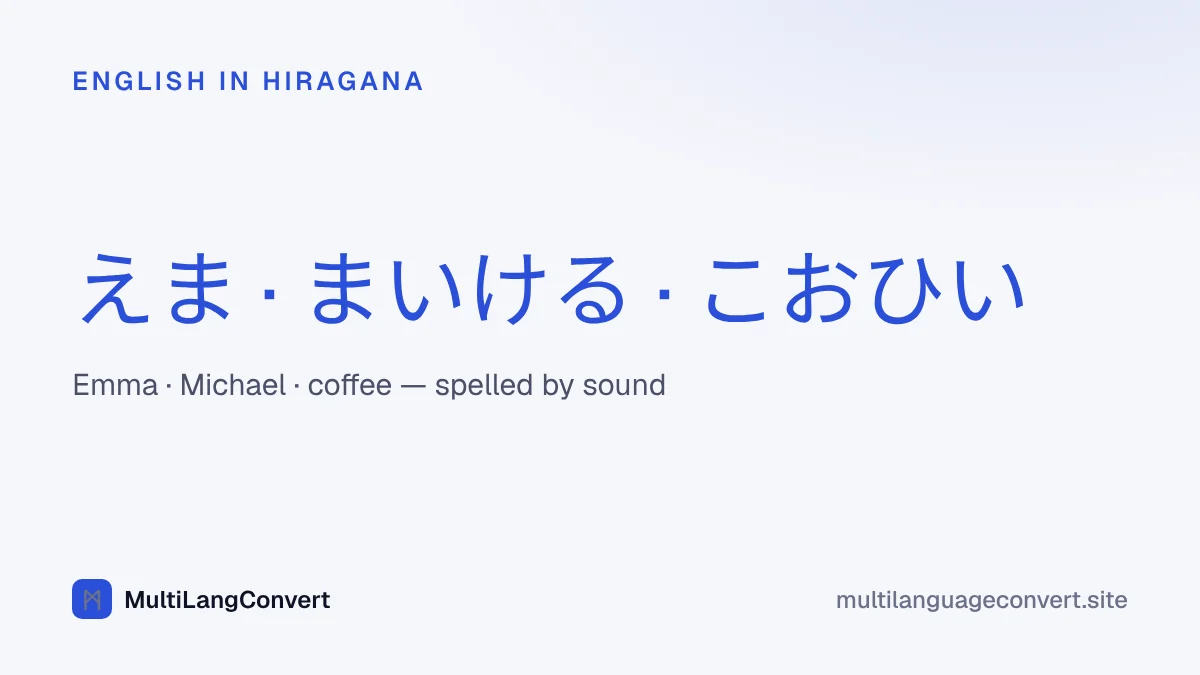
The short answer: to write English in hiragana, you spell the word by its sound in Japanese syllables, not by its English letters. Each hiragana character is a syllable such as ka, mi or to, so English sounds get adjusted to fit: “l” becomes r, “v” becomes b, and consonant clusters get extra vowels. Japanese normally uses katakana for foreign words and names, so hiragana versions are best for learning, cute designs and children’s text.
What is hiragana?
Hiragana is one of Japan’s two syllabaries, or kana. It has 46 basic characters, plus marked versions for voiced sounds (か ka → が ga) and small characters for combined sounds (き ki + ゃ → きゃ kya). The Unicode Hiragana chart lists all of them.
Japanese writing mixes three scripts: kanji (Chinese characters) for most content words, hiragana for grammatical endings and native words without common kanji, and katakana for foreign words, names and emphasis. Our guide to hiragana vs katakana vs kanji explains how they work together.
Why are English words usually written in katakana?
Since the 20th century, katakana has been the standard script for loanwords (gairaigo) and foreign names. Japan’s Agency for Cultural Affairs set out official guidance on writing foreign words in katakana in its 1991 notice Gairaigo no hyōki (bunka.go.jp).
So “coffee” is コーヒー (kōhī) in a café menu, not こーひー. Writing it in hiragana isn’t wrong, but it looks childlike or playful, much as writing “KoFFee” would in English. That’s exactly why hiragana versions are popular for cute names, learning materials and art.
How to convert English to hiragana, step by step
- Say the word aloud and listen to its sounds, not its spelling. “Knight” is n-ai-t.
- Break it into Japanese syllables. Japanese syllables are a vowel, or a consonant plus a vowel, or ん (n). “Knight” becomes na-i-to.
- Map each syllable to hiragana. な (na) い (i) と (to) → ないと.
- Mark long vowels. In hiragana, add the vowel again: “Sue” → すう. (The long-vowel bar ー is mainly a katakana convention.)
- Use small っ for doubled consonants. “Hot dog” → ほっとどっぐ.
- Use ん for a final n and before consonants: “Ben” → べん.
Examples
| English | Sounds | Hiragana | Standard katakana |
|---|---|---|---|
| Emma | e-ma | えま | エマ |
| Michael | ma-i-ke-ru | まいける | マイケル |
| Sarah | sē-ra | せえら | セーラ / サラ |
| Coffee | kō-hī | こおひい | コーヒー |
| Ice cream | a-i-su-ku-rī-mu | あいすくりいむ | アイスクリーム |
| London | ro-n-do-n | ろんどん | ロンドン |
English sounds that Japanese doesn’t have
Japanese has fewer distinct sounds than English, so some must be approximated. These are the standard substitutions.
| English sound | Becomes | Example |
|---|---|---|
| l | r-row (ら り る れ ろ) | Lily → りりい |
| v | b-row (ば び ぶ べ ぼ) | Victor → びくたあ |
| th (as in “think”) | s-row | Smith → すみす |
| th (as in “this”) | z-row | Heather → へざあ |
| si | し (shi) | Sid → しっど |
| ti, di | てぃ, でぃ (in katakana style) or ち, じ | Tina → てぃな |
| Final consonants | add u (or o after t, d) | Mark → まあく; Ted → てっど |
| Consonant clusters | vowel inserted | Steve → すてぃいぶ |
Linguists call this vowel insertion epenthesis. It’s why “strike” becomes sutoraiku in Japanese: s-u-t-o-r-a-i-k-u, five syllables for one English one.
Hiragana for names: tips for a natural result
- Follow the pronunciation you use. “Laura” can be ろーら or らうら, depending on accent.
- Check how Japanese media writes it. Famous names have set forms: “Emma Watson” is エマ・ワトソン.
- Keep it short. Drop sounds English speakers barely say, like the final r in British “Peter” (ぴーたー/ぴいたあ).
- Use a middle dot (・) between first and last names in katakana; hiragana versions can use a space.
Our Hiragana Translator converts English by sound using these rules and shows the romaji reading, so you can check each syllable.
How to read and type hiragana
Most learners use romaji, the Latin-letter spelling of Japanese. The Hepburn system, the most common, writes し as shi and ち as chi, matching English sounds. On a phone or computer, switching on the Japanese keyboard and typing romaji converts it to hiragana automatically: type “sakura” and you get さくら.
Common mistakes
- Converting letter by letter. “Kate” isn’t かてえ; it’s けいと (ke-i-to).
- Forgetting long vowels. こひ (kohi) and こおひい (kōhī) are different words to a Japanese ear.
- Using ー in hiragana everywhere. It’s fine in casual and manga text, but standard hiragana repeats the vowel.
- Expecting a “real” Japanese name. Hiragana spells your name’s sound; it doesn’t give it a Japanese meaning. For that, people choose kanji, which is a separate art.
Putting it together
To write English in hiragana, spell by sound: break the word into Japanese syllables, swap missing sounds (l → r, v → b), add vowels after lone consonants, and mark long vowels and doubled consonants. Remember that katakana is the normal choice for foreign words, so a hiragana name is a stylistic, often cute, choice.
Sources
- The Unicode Consortium, Hiragana code chart (U+3040–U+309F).
- Agency for Cultural Affairs, Government of Japan, Gairaigo no hyōki (Notation of loanwords), Cabinet Notice No. 2, 1991, bunka.go.jp.
- Natsuko Tsujimura, An Introduction to Japanese Linguistics (3rd ed., Wiley-Blackwell, 2014), on syllable structure and loanword adaptation.
- Timothy J. Vance, The Sounds of Japanese (Cambridge University Press, 2008).
- Kenkyusha, New Japanese-English Dictionary (5th ed., 2003), Hepburn romanization.