How Do You Say Hello in Navajo? 40 Essential Words
The most famous Navajo word is yá’át’ééh, “hello”. Literally, it means “it is good”, and that small detail says a lot about the language: Navajo builds meaning into verbs and descriptions in a way English doesn’t.
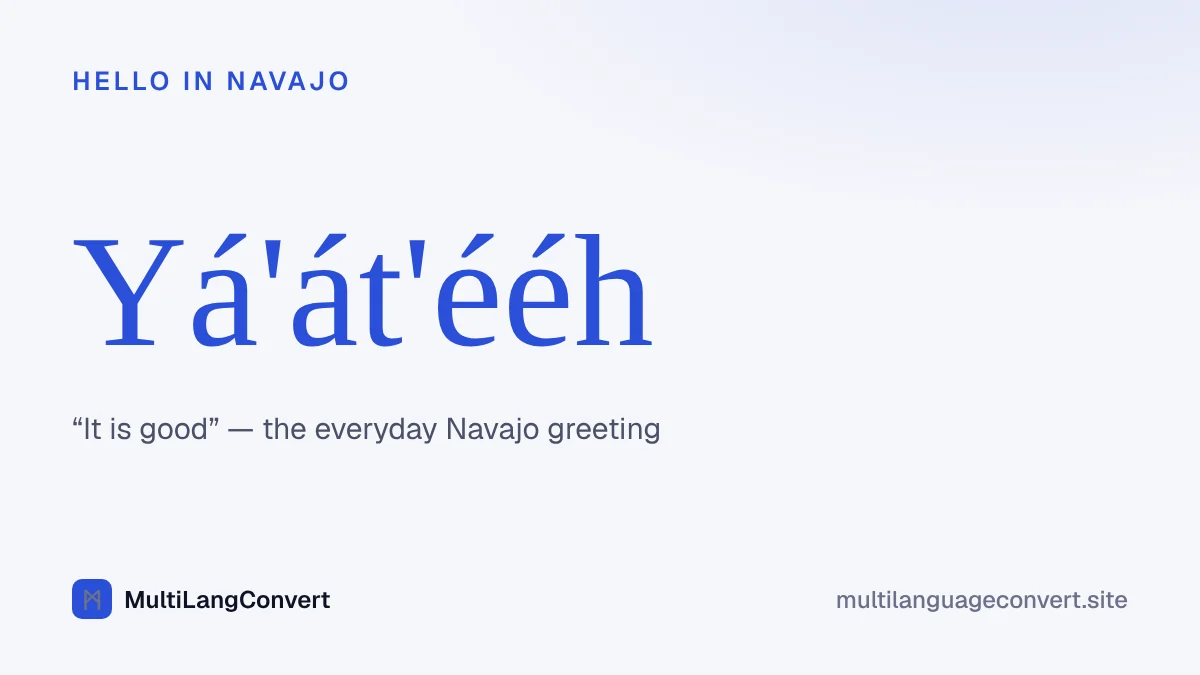
The short answer: to say hello in Navajo, say yá’át’ééh (roughly “yah-at-eh”, with a catch in the middle). “Thank you” is ahéhee’, “yes” is aoo’ and “no” is dooda. This guide gives 40 essential Navajo words and phrases with spelling and pronunciation tips, so you can greet people, count to ten and name family and everyday things correctly.
What is the Navajo language?
Navajo, or Diné bizaad (“the people’s language”), is spoken by the Navajo (Diné) people of the American Southwest, mainly in Arizona, New Mexico and Utah. Encyclopaedia Britannica classifies it as an Apachean language of the Athabaskan family, related to Apache and to languages of Alaska and western Canada.
It’s the most widely spoken Native American language in the United States. According to U.S. Census Bureau figures reported by KNAU Arizona Public Radio, more than 170,000 people spoke Navajo at home in 2019. In December 2024, Navajo Nation President Buu Nygren signed legislation making Diné bizaad the Nation’s official language.
The number of young speakers has fallen sharply, though. The Navajo Times reported Census-based figures showing the share of Navajo people who speak the language dropping from 93% in 1980 to 51% in 2010.
How do you pronounce Navajo?
Navajo spelling is consistent, so once you know the marks, you can read any word.
| Mark | Example | What it means |
|---|---|---|
| Accent (á) | yá’át’ééh | High tone: say the vowel with a higher pitch |
| Hook under a vowel (ą) | naadą́ą́’ | Nasal vowel, said partly through the nose |
| Double vowel (aa) | naaki | Long vowel: hold it longer |
| Apostrophe (‘) | ahéhee’ | Glottal stop, the catch in “uh-oh” |
| ł | łį́į́’ | Breathy “l”: put your tongue for l and blow air past it |
| t’, ts’, ch’, k’ | t’ááłá’í | Ejectives: a sharp popping release |
Tone and length change meaning, so the marks aren’t decoration. The Navajo Sound Profile from the University of New Mexico has recordings of each sound.
Navajo greetings and everyday phrases
| English | Navajo |
|---|---|
| Hello (it is good) | Yá’át’ééh |
| Good morning | Yá’át’ééh abíní |
| Thank you | Ahéhee’ |
| Goodbye / see you later | Hágoónee’ |
| Yes | Aoo’ |
| No | Dooda |
| What is your name? | Haash yinílyé? |
| Where are you from? | Háádę́ę́’ naniná? |
| I don’t know | Doo shił bééhózin da |
| I’m hungry | Dichin nishłį́ |
| I love you | Ayóó’ánííníshní |
| It is cold | Deesk’aaz |
In traditional Navajo introductions, people don’t just give their name. They introduce themselves through their four clans: mother’s clan, father’s clan, maternal grandfather’s clan and paternal grandfather’s clan. This system, called k’é, shows how the speaker is related to everyone listening.
Numbers 1 to 10 in Navajo
| Number | Navajo | Number | Navajo |
|---|---|---|---|
| 1 | t’ááłá’í | 6 | hastą́ą́ |
| 2 | naaki | 7 | tsosts’id |
| 3 | táá’ | 8 | tseebíí |
| 4 | dį́į́’ | 9 | náhást’éí |
| 5 | ashdla’ | 10 | neeznáá |
Family words: why “mother” needs a “my”
Navajo kinship terms almost always carry a possessive prefix. You don’t say “mother” on its own; you say “my mother”, “your mother” or “someone’s mother”. Shi- means “my”, ni- means “your” and a- means “someone’s”.
| English | Navajo |
|---|---|
| my mother | shimá |
| my father | shizhé’é |
| my grandmother (mother’s mother) | shimásání |
| my grandfather (mother’s father) | shicheii |
| my older sister | shádí |
| my older brother | shínaaí |
| my friend | shik’is |
| my child (little one) | shiyázhí |
Everyday nouns
| English | Navajo | English | Navajo |
|---|---|---|---|
| water | tó | sheep | dibé |
| fire | kǫ’ | horse | łį́į́’ |
| sun | jóhonaa’éí | dog | łééchąą’í |
| mountain | dził | corn | naadą́ą́’ |
| rain | níłtsą́ | food | ch’iyáán |
| snow | yas | traditional home | hooghan |
| day | jį́ | house, building | kin |
| night | tł’éé’ | beauty, harmony | hózhó |
Some Navajo words show the language’s history of contact. Béégashii (cow) comes from Spanish vaca, and béeso (money) from Spanish peso.
Why can’t Navajo be translated word for word?
Navajo verbs are famously complex. One verb can include the subject, object, direction, aspect and the shape of the thing being handled. There are different verbs for handling a round object, a long thin object, a flat flexible object and so on.
That’s why automatic translators, including ours, are reliable for words, greetings and set phrases but give only a word-by-word draft for full sentences. Our Navajo Translator translates English words and phrases with correct tone marks and flags any word it doesn’t have, instead of inventing one.
The same complexity is what made Navajo such a strong wartime code; read the story of the Navajo Code Talkers.
Respect and good practice
- Keep every mark. Tone, nasal hooks and glottal stops are part of the spelling.
- Be careful with sacred words. Some terms belong to ceremonies and aren’t used casually.
- Learn from speakers. Diné College and community programmes teach the language with cultural context.
- Ask before using Navajo commercially. For logos, products or tattoos, check with a fluent speaker.
Putting it together
Yá’át’ééh (hello), ahéhee’ (thank you), aoo’ (yes) and dooda (no) will take you a long way. Learn the marks for tone, nasal vowels and glottal stops, remember that family words carry “my” or “your”, and treat sentence translations as drafts to check with a speaker. Every word you learn helps keep Diné bizaad in daily use.
Sources
- Encyclopaedia Britannica, “Navajo language“.
- KNAU Arizona Public Radio, “Diné Bizaad adopted as official language of the Navajo Nation” (1 January 2025).
- Navajo Times, “Data shows huge reduction in Diné speakers” (16 November 2017).
- University of New Mexico, Navajo Sound Profile.
- Robert W. Young and William Morgan Sr., The Navajo Language: A Grammar and Colloquial Dictionary (rev. ed., University of New Mexico Press, 1987).
- Diné College, Tsaile, Arizona.