How Do You Write English in Sanskrit? A Simple Guide
Sanskrit words are already part of English: yoga, karma, mantra, nirvana, guru, avatar. When people want a full phrase in Sanskrit, for a tattoo, a yoga studio or a name, they meet a language with eight cases, three numbers and a script that joins letters together.
The short answer: to write English in Sanskrit, you translate the meaning into Sanskrit words, give each noun the right case ending, conjugate the verb, apply sound-joining rules (sandhi), and write the result in the Devanagari script, usually with a Latin transliteration in the IAST system. For a mantra or saying, quote a real text from the Vedas, Upanishads or Bhagavad Gita whenever one fits.
What is Sanskrit?
Sanskrit is the classical language of ancient India and one of the oldest documented Indo-European languages, related to Latin, Greek and English. Encyclopaedia Britannica explains that its most ancient documents, the Vedas, were composed in Vedic Sanskrit, generally dated by scholars from around 1500–1200 BC. Classical Sanskrit was later standardised by the grammarian Pāṇini, usually dated to about the 4th century BC.
The name saṃskṛta means “refined” or “well-formed”. Pāṇini’s grammar, the Aṣṭādhyāyī, describes the language in about 4,000 compact rules and is still studied by linguists.
Sanskrit isn’t extinct: it’s used in Hindu, Buddhist and Jain religious practice, taught in schools and universities, and listed among the scheduled languages of India’s constitution.
How does Sanskrit grammar work?
| Feature | Sanskrit | English equivalent |
|---|---|---|
| Cases | 8 (nominative, accusative, instrumental, dative, ablative, genitive, locative, vocative) | Word order and prepositions |
| Numbers | Singular, dual, plural | Singular, plural |
| Genders | Masculine, feminine, neuter | Only in pronouns |
| Verbs | Change for person, number, tense, mood and voice | Mostly helper words |
| Sandhi | Sounds change where words meet | Like “an apple” vs “a pear” |
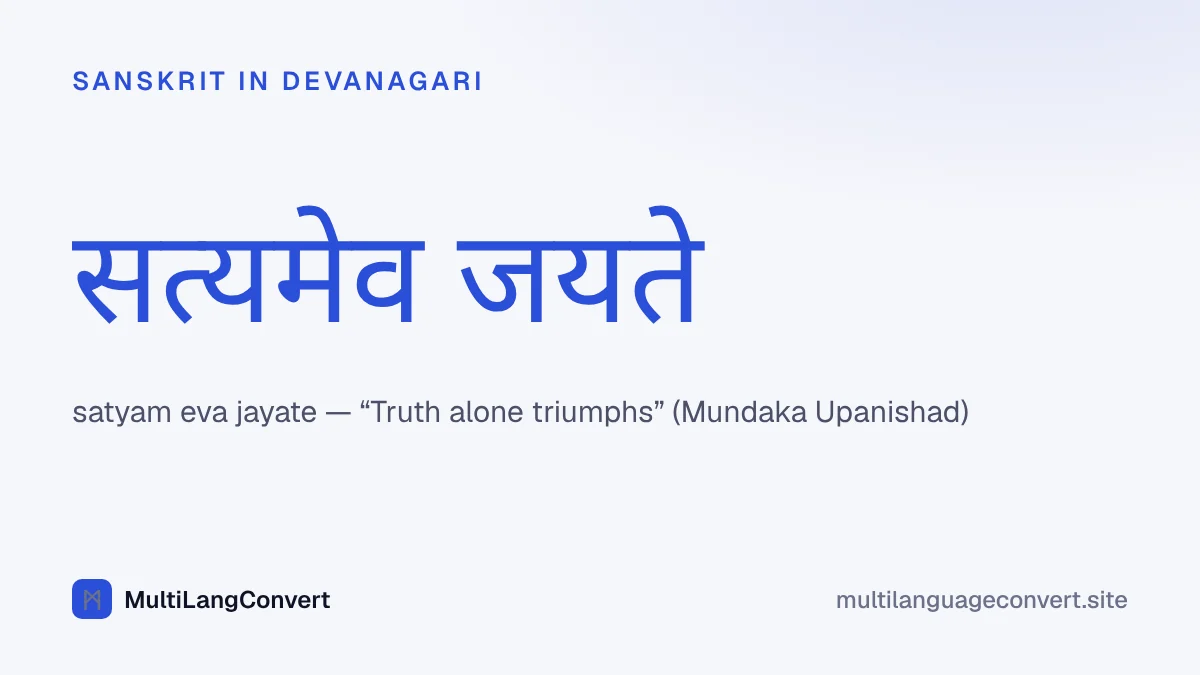
For example, “victory” is jaya, but “truth alone triumphs”, India’s national motto from the Mundaka Upanishad, is सत्यमेव जयते (satyam eva jayate). Here jayate is a verb form, “it wins”, and satyam eva joins into satyameva in writing.
How to write English in Sanskrit, step by step
- Check for an existing verse or saying. The Bhagavad Gita and Upanishads have well-known lines for courage, peace, duty and truth.
- Find the Sanskrit words in the Monier-Williams dictionary, freely searchable through the Cologne Digital Sanskrit Dictionaries.
- Choose the case for each noun: subject in the nominative, object in the accusative, “with” in the instrumental and so on.
- Conjugate the verb for person and number: gacchāmi (I go), gacchati (he/she goes), gacchāmaḥ (we go).
- Apply sandhi where words meet, or leave words separate in a simple modern style.
- Write in Devanagari and add IAST transliteration so non-readers can pronounce it.
Our Sanskrit Translator does this with a Sanskrit dictionary, case endings and verb forms, and shows both Devanagari and IAST.
Famous Sanskrit phrases
| Sanskrit (IAST) | Devanagari | Meaning | Source |
|---|---|---|---|
| satyam eva jayate | सत्यमेव जयते | Truth alone triumphs | Mundaka Upanishad 3.1.6 |
| vasudhaiva kuṭumbakam | वसुधैव कुटुम्बकम् | The world is one family | Maha Upanishad |
| ahiṃsā paramo dharmaḥ | अहिंसा परमो धर्मः | Non-violence is the highest duty | Mahabharata |
| oṃ śāntiḥ śāntiḥ śāntiḥ | ॐ शान्तिः शान्तिः शान्तिः | Om, peace, peace, peace | Closing of many Upanishadic prayers |
| tat tvam asi | तत्त्वमसि | That thou art | Chandogya Upanishad 6.8.7 |
What is IAST?
IAST, the International Alphabet of Sanskrit Transliteration, writes Sanskrit in Latin letters with marks for sounds English lacks: ā for a long a, ṭ and ḍ for retroflex sounds (tongue curled back), ś and ṣ for two kinds of sh, and ṃ for a nasal. Using IAST keeps the spelling exact; plain “satyam eva jayate” is fine for casual use, but scholars use the marks.
Common mistakes
- Using Hindi instead of Sanskrit. Both use Devanagari, but Hindi is a modern language with different grammar.
- Broken conjunct letters. Fonts that don’t join consonants (like त्त in tattvam) produce unreadable text.
- Missing the virāma. The small stroke (्) under a final consonant changes the word.
- Ignoring gender. “Brave” is vīraḥ for a man and vīrā for a woman.
Sanskrit isn’t the only ancient language whose famous phrases outlived daily speech; Latin mottos work the same way, as explained in how to translate English to Latin.
Putting it together
Writing in Sanskrit means translating, not transliterating: pick the words from Monier-Williams, add case endings and verb forms, join sounds with sandhi, and write in Devanagari with IAST. For mantras and mottos, the best Sanskrit is often a line that’s been chanted for thousands of years.
Sources
- Encyclopaedia Britannica, “Sanskrit language“.
- University of Cologne, Cologne Digital Sanskrit Dictionaries (Monier-Williams, 1899).
- Monier Monier-Williams, A Sanskrit-English Dictionary (Oxford, 1899).
- William Dwight Whitney, Sanskrit Grammar (2nd ed., 1889).
- Mundaka Upanishad 3.1.6; Chandogya Upanishad 6.8.7.
- Constitution of India, Eighth Schedule (languages).