What Is Coptic? The Last Stage of Ancient Egyptian Explained
If you want to write something in “ancient Egyptian” that a reader can actually pronounce, Coptic is the answer most people don’t know about. It’s the last stage of the Egyptian language, the same language as the hieroglyphs, but written in an alphabet based on Greek letters.
The short answer: Coptic is the final form of the ancient Egyptian language, written from about the 3rd century AD in the Greek alphabet plus six or seven extra letters taken from Egyptian Demotic script. It was the everyday language of Christian Egypt until Arabic replaced it, and it survives today as the liturgical language of the Coptic Orthodox Church. Because Coptic writes vowels, it’s the main evidence for how Egyptian words were actually pronounced.
How is Coptic related to hieroglyphs?
Egyptian is one language with a very long life, around 4,500 years of written records. Scholars divide it into stages, each with its own typical script.
| Stage | Approx. dates | Main script |
|---|---|---|
| Old Egyptian | c. 2600–2000 BC | Hieroglyphs |
| Middle Egyptian | c. 2000–1300 BC | Hieroglyphs, hieratic |
| Late Egyptian | c. 1300–700 BC | Hieratic, hieroglyphs |
| Demotic | c. 650 BC–AD 450 | Demotic script |
| Coptic | c. AD 200–1300 (spoken); liturgical today | Coptic alphabet |
Hieroglyphs record consonants only; Coptic adds the vowels. That’s why Egyptologists rely on Coptic to reconstruct pronunciation, and why Jean-François Champollion’s knowledge of Coptic was key to his decipherment of hieroglyphs in 1822. Our guide on how to read Egyptian hieroglyphs explains the earlier script.
What does the Coptic alphabet look like?
Coptic uses 24 Greek letters plus extra letters for Egyptian sounds that Greek lacked. In the Sahidic dialect these are:
| Letter | Name | Sound |
|---|---|---|
| ϣ | shai | sh |
| ϥ | fai | f |
| ϩ | hori | h |
| ϫ | janja | j / ky |
| ϭ | chima | ch / ky |
| ϯ | ti | ti |
The Bohairic dialect adds ϧ (khai) for a throaty kh. The Unicode Coptic chart encodes the full alphabet.
Sahidic vs Bohairic: which Coptic?
- Sahidic was the main literary dialect of Upper (southern) Egypt and the dialect of most early Coptic literature, including the Nag Hammadi codices. It’s what most university courses teach.
- Bohairic, from the Nile Delta, became the liturgical dialect of the Coptic Orthodox Church, so it’s the Coptic heard in churches today.
Coptic words with familiar roots
| Coptic | Meaning | Connection |
|---|---|---|
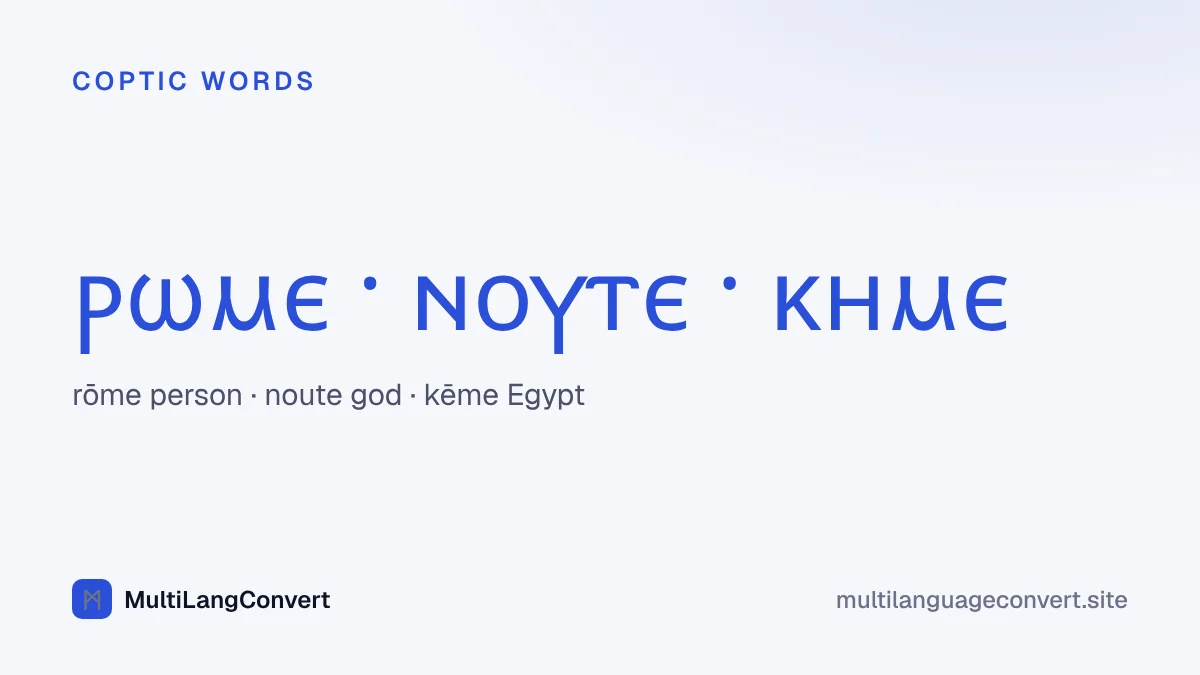
| ⲣⲱⲙⲉ (rōme) | person | Egyptian rmṯ |
| ⲛⲟⲩⲧⲉ (noute) | god | Egyptian nṯr |
| ⲣⲏ (rē) | sun | The sun god Ra |
| ⲕⲏⲙⲉ (kēme) | Egypt | Egyptian kmt, “the black land” |
| ⲟⲩⲁⲁⲃ (ouaab) | holy, pure | Egyptian wꜥb |
English even has a word that may come from Egyptian via Coptic: “oasis” is usually traced through Greek to Egyptian wḥꜣt, Coptic ouahe.
How to translate English into Coptic
- Find the word in the Coptic Dictionary Online, built by the KELLIA project from Crum’s classic dictionary.
- Choose the dialect, Sahidic for ancient texts, Bohairic for church use.
- Add the article as a prefix: ⲡ- (masculine), ⲧ- (feminine), ⲛ- (plural): ⲡⲣⲱⲙⲉ “the man”.
- Build the verb with a conjugation base: Coptic marks tense and person with a prefix before the verb, e.g. ϯ- “I” in the present (ϯⲙⲉ “I love”).
- Write in Coptic letters and add transliteration.
Our Coptic Translator translates into Sahidic Coptic in the Coptic alphabet with transliteration, using a Coptic word list and these prefix rules.
Is Coptic still spoken?
Britannica notes that by the 12th century Arabic was in common use even among Copts, and that Coptic survives as a liturgical language of the Coptic Orthodox Church. Some families and revival groups teach it, but it has no community of native speakers today.
Putting it together
Coptic is Egyptian, the language of the pharaohs, in its final form: written in Greek-based letters with a few Egyptian additions, and full of vowels the hieroglyphs never showed. Choose Sahidic or Bohairic, check words in the Coptic Dictionary Online, attach articles and verb prefixes, and you can write a phrase an Egyptian of the 4th century would recognise.
Sources
- Coptic Dictionary Online (KELLIA project; based on W. E. Crum, A Coptic Dictionary, Oxford, 1939).
- Encyclopaedia Britannica, “Egypt: Languages” and “Coptic language“.
- The Unicode Consortium, Coptic code chart.
- Bentley Layton, Coptic in 20 Lessons (Peeters, 2007).
- Thomas O. Lambdin, Introduction to Sahidic Coptic (Mercer University Press, 1983).