Biblical Hebrew vs Modern Hebrew: What’s the Difference?
Biblical Hebrew and Modern Hebrew use the same alphabet and many of the same words, and an Israeli schoolchild can read the opening of Genesis. Yet they aren’t the same language stage, and the difference matters if you want a verse, a name or a tattoo that sounds authentic.
The short answer: Biblical Hebrew is the Hebrew of the Hebrew Bible, written roughly between 1000 and 200 BC. It often puts the verb first and uses a special “consecutive” verb form to tell stories. Modern Hebrew was revived as a spoken language from the late 19th century and is now the language of Israel, with subject-verb-object word order, simpler tenses and thousands of new words. For a biblical phrase, use Biblical Hebrew with full vowel points; for a message to a living speaker, use Modern Hebrew.
What is Biblical Hebrew?
Biblical (or Classical) Hebrew is a Northwest Semitic language, closely related to Phoenician and Aramaic. Encyclopaedia Britannica notes that spoken Hebrew was gradually supplanted by Aramaic from about the 3rd century BC, though Hebrew lived on as a language of prayer, scholarship and literature until its revival as a spoken language in the 19th and 20th centuries.
The vowel signs you see in printed Bibles, called niqqud (vowel points), were added later by scholars known as the Masoretes, between about the 7th and 10th centuries AD. The original texts were written with consonants only. The Leningrad Codex, from about AD 1008, is the oldest complete manuscript of the Hebrew Bible with full Masoretic vowels.
What is Modern Hebrew?
Modern Hebrew grew out of a revival movement in the late 1800s, associated with Eliezer Ben-Yehuda, who compiled a large dictionary and raised his son as a Hebrew speaker. Today it’s one of the official languages of Israel and is spoken natively by millions of people.
The Academy of the Hebrew Language in Jerusalem regulates new words, such as maḥshev (computer) from the root for “think”.
Biblical vs Modern Hebrew: key differences
| Feature | Biblical Hebrew | Modern Hebrew |
|---|---|---|
| Word order | Often verb-subject-object | Usually subject-verb-object |
| Narrative past | Wayyiqtol: wayyōmer “and he said” | Simple past: amar “he said” |
| Tenses | Aspect-based (complete vs incomplete) | Past, present, future |
| Vowel points | Fully pointed in printed Bibles | Usually left out in everyday writing |
| Vocabulary | About 8,000 different words in the Bible | Tens of thousands, including modern coinages |
| Pronunciation | Reconstructed; varied traditions | Israeli standard |
Same verse, two styles
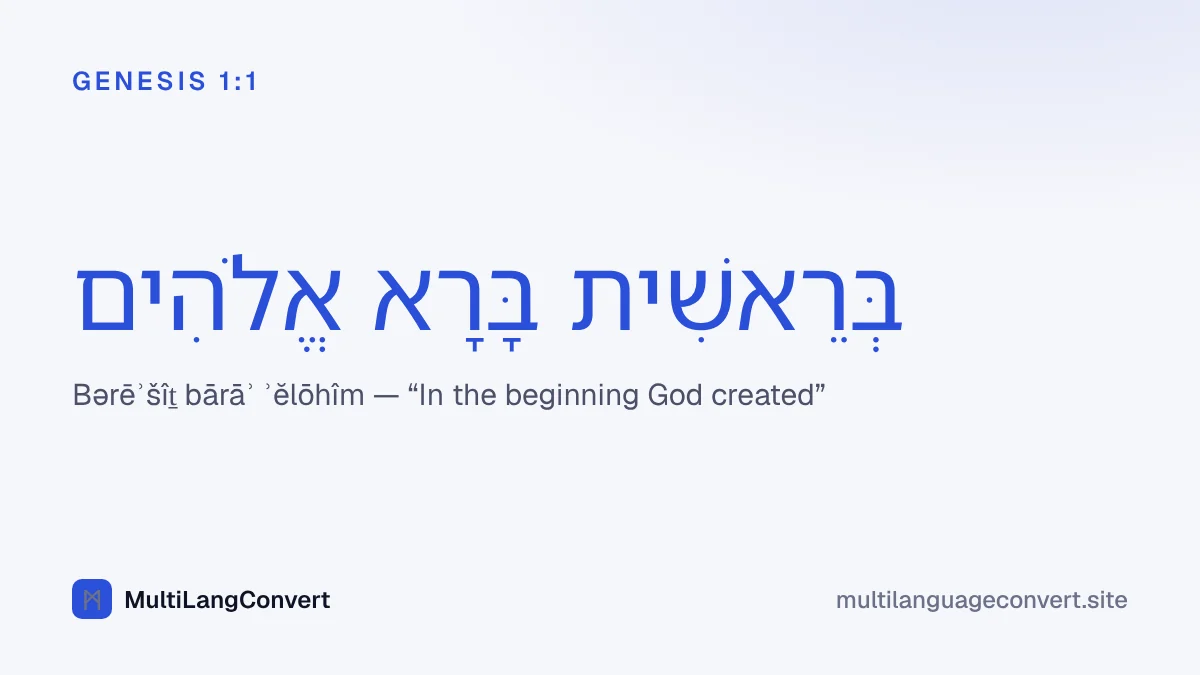
Genesis 1:1 in Biblical Hebrew is בְּרֵאשִׁית בָּרָא אֱלֹהִים אֵת הַשָּׁמַיִם וְאֵת הָאָרֶץ (Bərēʾšîṯ bārāʾ ʾĕlōhîm ʾēṯ haššāmayim wəʾēṯ hāʾāreṣ), “In the beginning God created the heavens and the earth”. The verb bārāʾ comes before the subject ʾĕlōhîm, a typical biblical order. A modern writer would more often put the subject first.
How to translate English into Biblical Hebrew
- Look for the phrase in the Bible first. If your idea is a verse, quote it exactly. Sefaria gives the Hebrew text with English translations.
- Find words in a biblical lexicon, such as Brown–Driver–Briggs or Strong’s concordance, not a modern dictionary.
- Mark gender. “You” and verbs differ for a man and a woman: ʾattâ (m) vs ʾatt (f).
- Attach small words. “And”, “the”, “in” and “to” join the front of the next word: wə-, ha-, bə-, lə-.
- Add vowel points so the reading is unambiguous, and write right to left.
Our Biblical Hebrew Translator translates from a biblical word list with full vowel points and a transliteration, and gives famous verses as exact quotations.
Common mistakes
- Reversed text. Hebrew pasted into some design software comes out left to right; check that the first letter is on the right.
- Final letter forms. Five letters have special forms at the end of a word: ך ם ן ף ץ.
- Using modern words for a “biblical” text. Biblical Hebrew has no word for “coffee” or “forever and always” as one modern idiom.
- Mixing Hebrew and Aramaic. Some biblical books contain Aramaic sections; see how Aramaic translation works.
Putting it together
Biblical Hebrew is the ancient, verb-first language of the Bible, best written with Masoretic vowel points; Modern Hebrew is its revived, living descendant. Quote real verses where you can, use a biblical lexicon, mark gender and attached prefixes, and check the right-to-left direction before you print anything.
Sources
- Encyclopaedia Britannica, “Hebrew language“.
- Sefaria, Hebrew Bible texts and translations.
- Academy of the Hebrew Language, Jerusalem.
- Francis Brown, S. R. Driver and Charles A. Briggs, A Hebrew and English Lexicon of the Old Testament (Oxford, 1906).
- Thomas O. Lambdin, Introduction to Biblical Hebrew (Scribner, 1971).
- Ghil’ad Zuckermann, Revivalistics (Oxford University Press, 2020), on the revival of Hebrew.