Classical Chinese vs Modern Chinese: Key Differences Explained
The opening line of Confucius’s Analects is just six characters: 學而時習之 (“to learn and regularly practise it”). Modern Mandarin needs about twice as many to say the same thing. That compression is the heart of Classical Chinese, and it’s why translating into it is different from translating into modern Chinese.
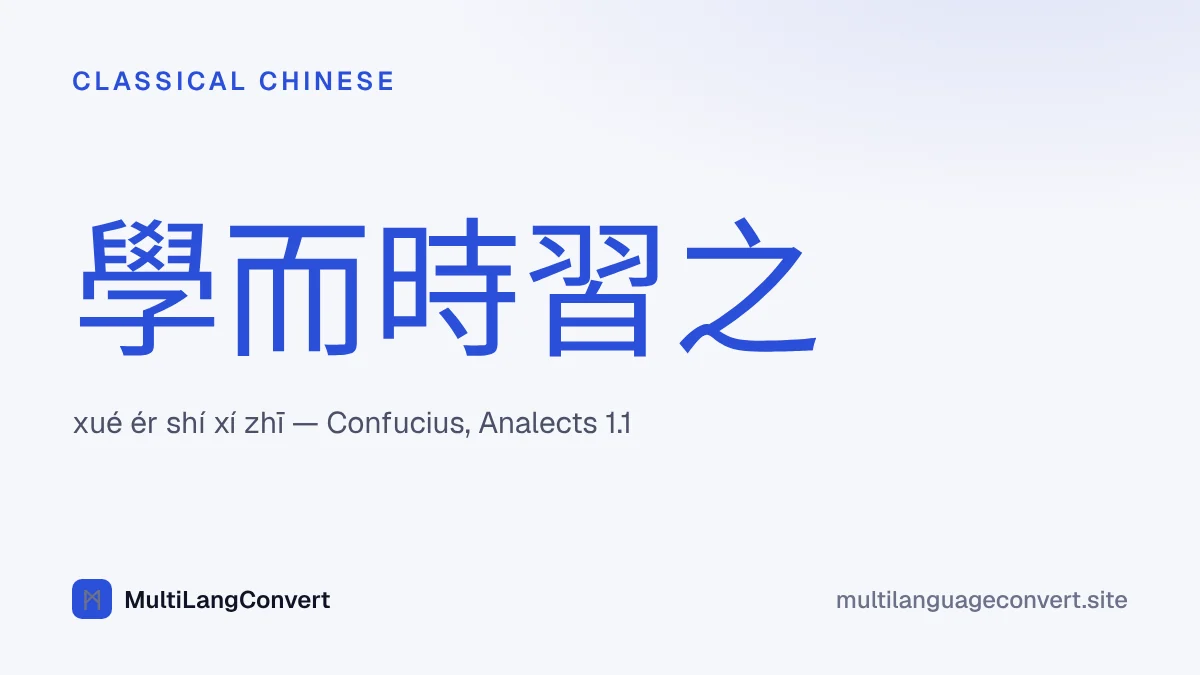
The short answer: Classical Chinese (文言文, wényánwén) is the written language of ancient China, used for philosophy, history and literature from about the 5th century BC and for formal writing until the early 20th century. It’s extremely concise: most words are a single character. Modern Chinese (白話, báihuà, and today’s Mandarin) is based on everyday speech, uses many two-character words and adds grammatical particles. For a proverb, motto or calligraphy, Classical Chinese in traditional characters is the classic choice.
What is Classical Chinese?
Classical Chinese is the language of the Confucian classics, Laozi’s Daodejing, Sunzi’s Art of War and the great histories. For two thousand years it was also the shared written language of educated people across East Asia, read in Japan, Korea and Vietnam with local pronunciations.
It stopped being the standard for writing after the May Fourth Movement of 1919, when reformers such as Hu Shi pushed for writing in the vernacular. It’s still taught in Chinese schools, and its phrases survive in thousands of four-character idioms (成語, chéngyǔ).
The Chinese Text Project provides the full texts of the classics with translations and a dictionary of how each character was used.
Classical vs Modern Chinese: key differences
| Feature | Classical Chinese | Modern Mandarin |
|---|---|---|
| Word length | Mostly one character | Mostly two characters |
| “I” | 吾 wú / 我 wǒ / 余 yú | 我 wǒ |
| “is” (copula) | Usually none; 也 yě at the end | 是 shì |
| “not” | 不 bù, 弗 fú, 未 wèi, 非 fēi | 不 bù, 沒 méi |
| Possessive | 之 zhī | 的 de |
| Question | 乎 hū, 哉 zāi at the end | 嗎 ma |
| “water” / “eye” | 水 / 目 | 水 / 眼睛 |
| Used for | Classics, poetry, calligraphy, idioms | Everyday speech and writing |
Example
“Knowledge is power” in Modern Mandarin is 知識就是力量 (zhīshi jiùshì lìliàng), six characters with the copula 就是. A classical writer would more likely reach for a line from the classics, such as 知之為知之,不知為不知,是知也 (“to know what you know, and to know what you don’t know: that is knowledge”, Analects 2.17). Notice the pattern: single-character words, 是 meaning “this” rather than “is”, and 也 closing the statement.
Traditional or simplified characters?
Classical texts are traditionally printed in traditional characters (繁體字), the forms used before mainland China’s simplification in the 1950s and 1960s. Taiwan, Hong Kong and Macau still use them. For calligraphy, tattoos or a classical feel, traditional is the authentic choice: 學 rather than 学, 龍 rather than 龙.
The Unicode Unihan database records both forms and their definitions.
How to translate English into Classical Chinese
- Look for an existing classical line or idiom that matches your meaning.
- Use single-character words. “Mountain” is 山, “heart/mind” is 心, “dragon” is 龍.
- Drop modern particles like 的 and 是; use 之 and 也 sparingly.
- Keep word order subject-verb-object, as in modern Chinese, but leave out words the context makes clear.
- Write in traditional characters and add pinyin for pronunciation.
Our Classical Chinese Translator translates into Literary Chinese using single-character classical vocabulary in traditional characters with pinyin, and gives famous lines from Confucius, Laozi and Sunzi as exact quotations.
Famous classical lines
| Classical Chinese | Meaning | Source |
|---|---|---|
| 學而時習之,不亦說乎 | To learn and practise it regularly, is that not a pleasure? | Analects 1.1 |
| 千里之行,始於足下 | A journey of a thousand li begins beneath one’s feet | Daodejing 64 |
| 知彼知己,百戰不殆 | Know the enemy and know yourself; in a hundred battles you will not be endangered | Art of War 3 |
| 上善若水 | The highest good is like water | Daodejing 8 |
Common mistakes
- Using modern Mandarin and calling it ancient.
- Using simplified characters for classical quotes.
- Single characters out of context. 愛 (love) alone is fine, but strings of characters without grammar don’t make a sentence.
- Japanese kanji mix-ups. Some Japanese forms differ (e.g. 学 in Japanese vs 學 in traditional Chinese).
Japanese borrowed Chinese characters and later developed its own syllabaries; see hiragana vs katakana vs kanji.
Putting it together
Classical Chinese is terse, elegant and built from single characters; modern Chinese is longer and closer to speech. Quote a classic when you can, write in traditional characters, prefer one-character words, and add pinyin so readers can say it.
Sources
- Chinese Text Project (Analects, Daodejing, Art of War).
- The Unicode Consortium, Unihan Database.
- Encyclopaedia Britannica, “Chinese languages“.
- Edwin G. Pulleyblank, Outline of Classical Chinese Grammar (UBC Press, 1995).
- Michael A. Fuller, An Introduction to Literary Chinese (rev. ed., Harvard University Asia Center, 2004).