What Does Corporate Jargon Really Mean? 30 Phrases Decoded
“Let’s circle back on this offline and take it as an action item for Q3.” Plenty of people have heard a sentence like that and wondered what, exactly, was decided. Corporate jargon is a dialect of English, and like any dialect it can be translated both ways.
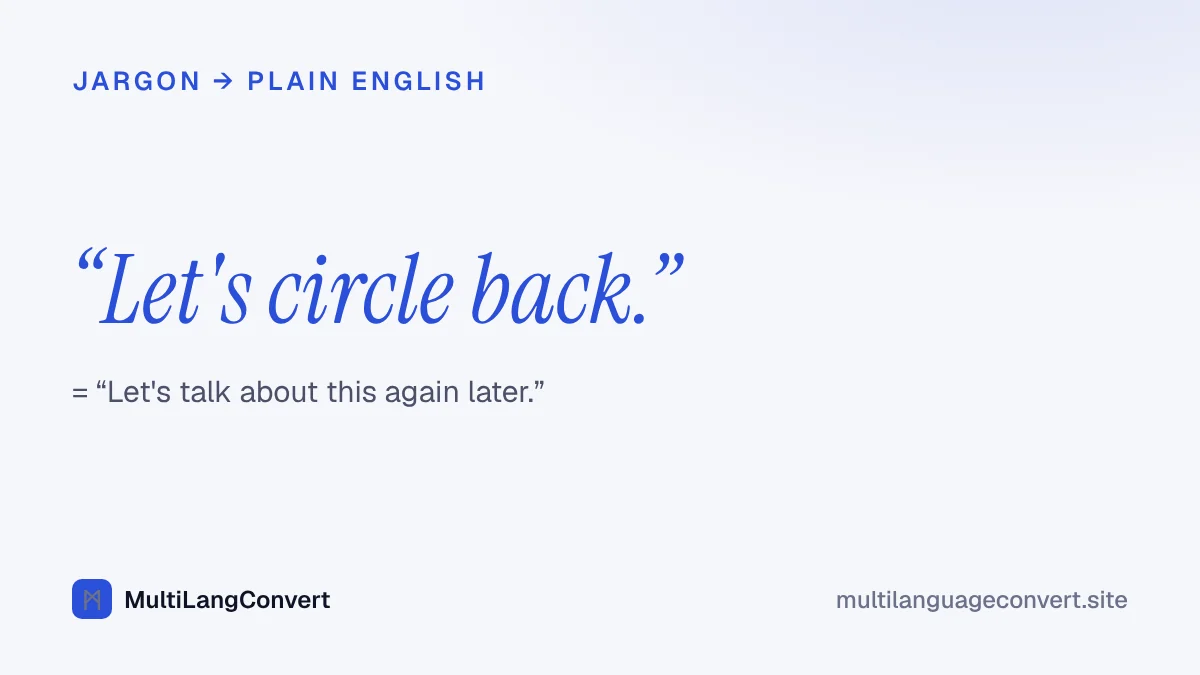
The short answer: corporate jargon is the specialised, often euphemistic language of offices, meetings and business email. Most phrases have a plain-English equivalent: “circle back” means “discuss again later”, “bandwidth” means “time or capacity”, and “take this offline” means “talk about it privately, not in this meeting”. Translating jargon into plain English makes messages clearer; translating plain English into corporate style can make it sound more polished and diplomatic.
What is corporate jargon?
Corporate jargon is vocabulary that grows up inside workplaces: management terms, metaphors from sport and the military, technology words used for people, and polite phrases that soften bad news. Some of it is useful shorthand among colleagues. Much of it confuses outsiders, new hires and people working in a second language.
Workers notice. A survey of American white-collar workers by the language-learning company Preply, reported by NPR in September 2023, found that “circling back” and “touching base” topped the list of terms people most wanted to stop hearing.
Clear-writing guides agree. The US Plain Language Action and Information Network, which supports the Plain Writing Act of 2010, advises federal writers to choose everyday words over jargon, and the UK government’s GOV.UK style guidance gives similar advice for public-sector writing.
30 corporate phrases decoded
| Corporate phrase | Plain English |
|---|---|
| Circle back | Talk about this again later |
| Touch base | Check in briefly |
| Take this offline | Let’s discuss it privately, not now |
| Bandwidth | Time, energy or capacity |
| Low-hanging fruit | Easy wins |
| Move the needle | Make a noticeable difference |
| Leverage | Use |
| Synergy | Working together better than separately |
| Deep dive | Detailed look |
| Action item | Task |
| Deliverable | Something you have to hand in |
| Going forward | From now on |
| Per my last email | As I already told you |
| Let’s park that | Let’s leave that for now |
| Boil the ocean | Try to do far too much |
| Ping me | Send me a message |
| On my radar | I’m aware of it |
| Not on my plate | Not my job right now |
| Run it up the flagpole | Test the idea |
| Pivot | Change direction |
| Learnings | Lessons |
| Align on | Agree on |
| Stakeholders | People affected or involved |
| Best practice | The usual good way to do it |
| Quick win | Easy improvement |
| Rightsizing | Cutting jobs |
| Opportunity for growth | Weakness |
| Let’s put a pin in it | Let’s pause this topic |
| EOD / COB | End of the working day |
| Open the kimono | Share information (avoid: widely seen as inappropriate) |
Why do people use corporate jargon?
- Speed among insiders. “EOD” or “deliverable” saves words when everyone knows the meaning.
- Diplomacy. “Let’s take this offline” ends a tangent without embarrassing anyone.
- Softening bad news. “Rightsizing” sounds gentler than “layoffs”, which is exactly why critics object to it.
- Belonging. Shared vocabulary signals membership of a team or industry, like any group slang.
- Sounding confident. Some people use jargon to appear knowledgeable, which can backfire with listeners who see through it.
When should you translate jargon into plain English?
Plain English wins whenever clarity matters more than tone.
- Emails to customers or the public. They don’t share your office vocabulary.
- Messages to colleagues working in a second language. Idioms like “boil the ocean” don’t translate.
- Instructions, deadlines and decisions. “Let’s circle back” can leave everyone unsure who does what.
- Anything legal or financial. Vague words create risk.
Our Corporate English Translator works both ways: it can turn blunt text into polished business language, or decode jargon into plain English.
Example: both directions
| Plain English | Corporate style |
|---|---|
| I don’t have time for this. | I don’t have the bandwidth to take this on right now. |
| Your idea won’t work. | I’m not sure this aligns with our current priorities. |
| Do this by Friday. | Could we target end of week for this deliverable? |
| We messed up. | We’ve identified some learnings from this project. |
The corporate versions are more diplomatic, but they’re also vaguer. “Could we target end of week” sounds like a question; if Friday is a firm deadline, say so.
Corporate English vs “premium” English
Corporate style and elegant English aren’t the same. Corporate English uses workplace vocabulary and soft phrasing. “Premium” or refined English uses precise, rich vocabulary and well-built sentences, the kind of writing you’d expect from a good editor. For that, our Premium English Translator upgrades plain text without adding office jargon.
Language that signals a group is everywhere, from offices to playgrounds; see how Gen Alpha slang spreads for the same effect in a very different crowd.
How to write without jargon
- Name the action. Replace “leverage” with “use”, “facilitate” with “help” or “run”.
- Name the person and the date. “Aisha will send the draft by Thursday” beats “let’s circle back”.
- Cut metaphors. “Move the needle” → “increase sales by 5%”.
- Read it aloud. If you wouldn’t say it to a friend, simplify it.
Putting it together
Corporate jargon is a workplace dialect: sometimes useful shorthand, often vague, occasionally a way to hide bad news. Decode it with a phrase list like the one above, use it sparingly when diplomacy helps, and switch to plain English for deadlines, decisions and anyone outside the team.
Sources
- NPR, “Tired of ‘circling back’ and ‘touching base’? How to handle all the workplace jargon” (5 September 2023), reporting a Preply survey.
- Plain Language Action and Information Network, Federal Plain Language Guidelines.
- Plain Writing Act of 2010, Public Law 111-274 (United States).
- Don Watson, Death Sentence: The Decay of Public Language (Knopf, 2003).