Elder Futhark vs Younger Futhark vs Futhorc: The Differences Explained
The three main rune alphabets are the Elder Futhark (24 runes, about AD 150–800), the Younger Futhark (16 runes, the Viking Age, about AD 800–1100) and the Anglo-Saxon Futhorc (28 or more runes, England, about AD 450–1100). They share an ancestor and many shapes, but they wrote different languages at different times, so the “right” one depends on what you want to write.
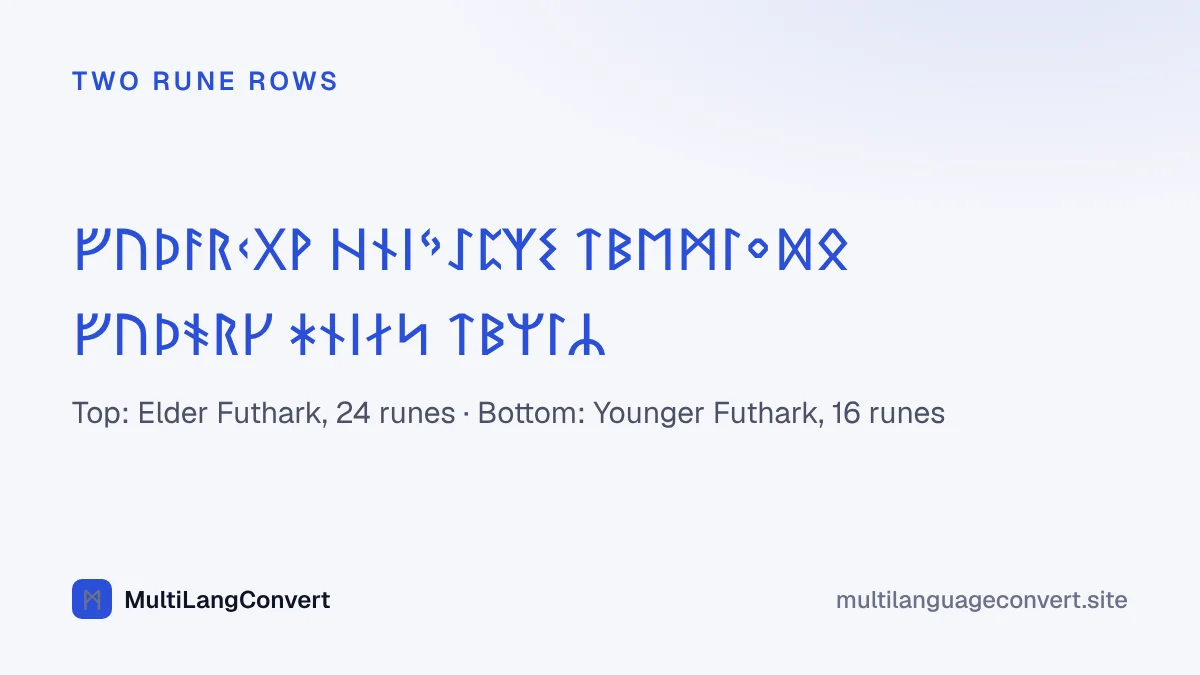
The short answer
| Elder Futhark | Younger Futhark | Anglo-Saxon Futhorc | |
|---|---|---|---|
| Number of runes | 24 | 16 | 28 (up to 33 in Northumbria) |
| Period | c. AD 150–800 | c. AD 800–1100 (and later) | c. AD 450–1100 |
| Where | Scandinavia and continental Europe | Scandinavia and Viking settlements | England and Frisia |
| Language | Proto-Norse and early Germanic dialects | Old Norse | Old English and Old Frisian |
| Known for | Golden horns of Gallehus, Kylver stone | Jelling stones, Rök stone, Viking graffiti | Franks Casket, Ruthwell Cross |
| First six runes | ᚠᚢᚦᚨᚱᚲ | ᚠᚢᚦᚬᚱᚴ | ᚠᚢᚦᚩᚱᚳ |
How did one alphabet become three?
All three come from the Elder Futhark, which appears fully formed in inscriptions from the 2nd century AD. Its origin is still debated. Most runologists think it was modelled on a Mediterranean alphabet, probably an Old Italic script or Latin, by Germanic people in contact with the Roman world. Shapes such as ᚱ (r), ᛒ (b) and ᛏ (t) look a lot like Roman R, B and T.
Languages change, and the runes changed with them, in two opposite directions.
In Scandinavia: fewer runes
During the 8th century, Scandinavian carvers dropped eight runes. This is surprising, because Old Norse was gaining sounds, not losing them. The result was an alphabet where one rune covered several sounds: ᚢ for u, o, w and y; ᛁ for i and e; ᚴ for k and g; ᛏ for t and d; ᛒ for b and p. Readers relied on context. Scholars still argue about why it happened; one common explanation is that fewer, simpler runes were faster to carve and learn. The Younger Futhark came in two styles: long-branch runes (often called Danish) and short-twig runes (Swedish-Norwegian, or Rök runes), which use the smallest possible number of strokes.
In England: more runes
Old English sound changes went the other way. The old a-rune came to stand for o (so the row became futhorc instead of futhark), and new runes were added for a, æ, y and the diphthong ea. Manuscript lists give 28 runes. In Northumbria, carvers added a few more, such as calc (ᛣ) for a k sound and gār (ᚸ) for a hard g, reaching about 33.
The same name in all three
Here is how our tools write the same names. Notice how the Younger Futhark merges sounds and how the Futhorc uses its own vowels.
| Name | Elder Futhark | Younger Futhark | Anglo-Saxon Futhorc |
|---|---|---|---|
| Thor | ᚦᛟᚱ | ᚦᚬᚱ | ᚦᚩᚱ |
| Odin | ᛟᛞᛁᚾ | ᚬᛏᛁᚾ | ᚩᛞᛁᚾ |
| Gunnar | ᚷᚢᚾᚨᚱ | ᚴᚢᚾᛅᚱ | ᚷᚢᚾᚪᚱ |
| Edda | ᛖᛞᚨ | ᛁᛏᛅ | ᛖᛞᚪ |
In the Younger Futhark, Edda becomes ᛁᛏᛅ, literally “ita”. That is not a mistake by the tool; it is exactly the kind of spelling Viking-age carvers produced, and it is why reading the Younger Futhark takes practice.
Which one should you use?
- Vikings, Norse mythology as the Vikings told it, Iceland, the sagas: the Younger Futhark Translator. It is the alphabet of the Viking Age.
- Earlier Germanic history, or the “classic” rune row seen in most modern books and games: the Runic Translator.
- England, Old English words, Anglo-Saxon names: the Anglo-Saxon Runes Translator.
Many modern designs mix rows, for example a Viking name in Elder Futhark runes. That is a style choice rather than an error, but if historical accuracy matters to you, match the row to the period.
A note on rune meanings
Every rune had a name that was an ordinary word: fehu (cattle, wealth), ūruz (aurochs), þurisaz (giant). The names helped people remember the sounds, the way children learn “A is for apple”. We know the names from rune poems written down in the Middle Ages, one in Old English and two in Old Norse. The idea of using runes mainly for fortune-telling, with a fixed meaning for each rune, is largely modern. It owes most to 20th-century writers. Some ancient inscriptions do look like charms, but most surviving ones record names, ownership and memorials.
Direction, word breaks and other habits
All three rows were normally read left to right, but carvers were flexible. Some early inscriptions run right to left, with the runes mirrored, and some snake back and forth (boustrophedon). On Viking-age stones the text often runs inside the curving body of a serpent, so you read it by following the snake. Words were split with one or two dots, a small cross, or not at all, and a rune was rarely doubled even when the sound was long. Bind runes, where two runes share a stave, appear too, especially in the Elder Futhark. Modern designs can borrow any of these habits, but keep them consistent so the text stays readable.
Where to see real runes
Scandinavia has about 3,000 runestones, most of them in Sweden and most from the late Viking Age, and many still stand where they were raised. The Jelling stones in Denmark are a UNESCO World Heritage Site. In England, the Ruthwell Cross (Dumfriesshire, Scotland) and the Franks Casket (British Museum) are the finest Anglo-Saxon examples. Many inscriptions have been photographed and catalogued online by Scandinavian and British universities, which makes it easy to compare your own runes with the real thing.
Sources
- The Unicode Consortium, Runic code chart
- Scandinavian Runic-text Database, Uppsala University.
- UNESCO World Heritage Centre, “Jelling Mounds, Runic Stones and Church“.
- Encyclopaedia Britannica, “Old Norse language“.
- Michael P. Barnes, Runes: A Handbook (Boydell, 2012).