How Does a Freak Translator Work? Fancy Text Explained
You’ve seen it in Instagram bios and gaming names: 𝓯𝓪𝓷𝓬𝔂 script, 𝔊𝔬𝔱𝔥𝔦𝔠 letters, ⓑⓤⓑⓑⓛⓔⓢ or ᵗⁱⁿʸ text. It looks like a font, but you can paste it anywhere, even where fonts can’t be changed. That’s because it isn’t a font at all.
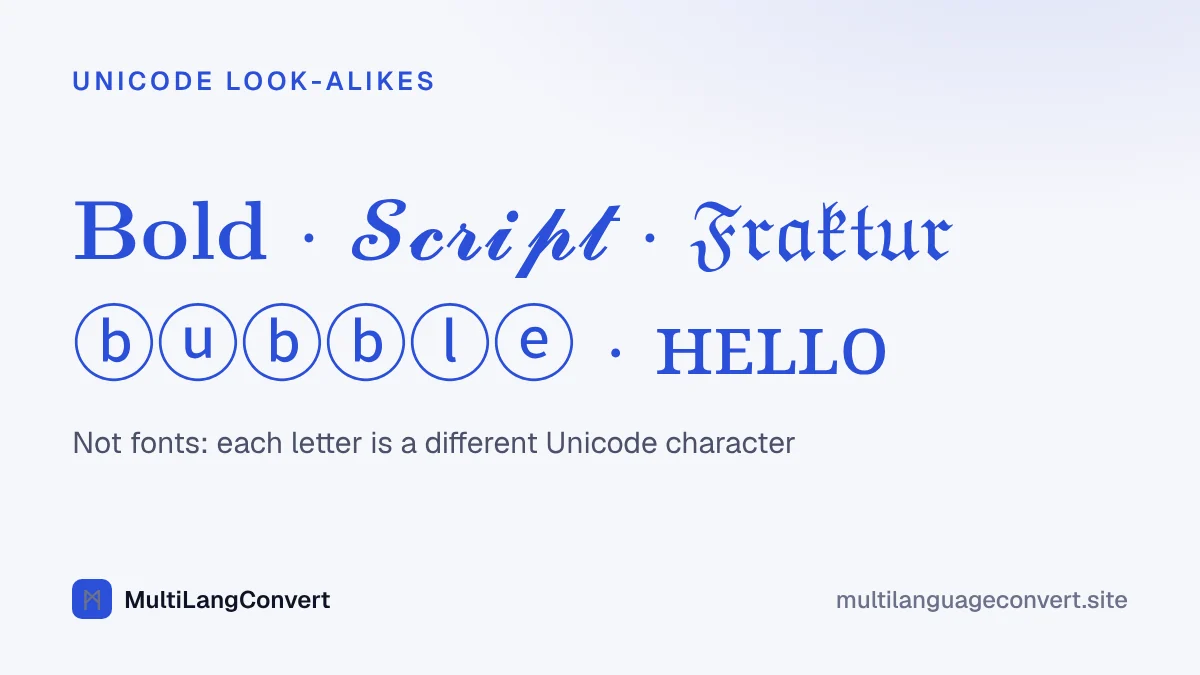
The short answer: a “freak translator” or fancy text generator swaps each normal letter for a different Unicode character that happens to look like a styled version of it. 𝐀 (Mathematical Bold Capital A) and A (Latin Capital A) are separate characters with separate codes, so the style travels with the text. The trade-off: screen readers and search engines may not read these characters as normal words.
Why does fancy text work everywhere?
Unicode is the international standard that gives every character in every writing system a number, so all devices display the same text. It includes several blocks of letter-like symbols originally added for maths and other specialised uses.
| Style | Example | Unicode source |
|---|---|---|
| Bold | 𝐇𝐞𝐥𝐥𝐨 | Mathematical Alphanumeric Symbols |
| Italic | 𝐻𝑒𝑙𝑙𝑜 | Mathematical Alphanumeric Symbols |
| Script | 𝓗𝓮𝓵𝓵𝓸 | Mathematical Alphanumeric Symbols |
| Fraktur (“Gothic”) | 𝔥𝔢𝔩𝔩𝔬 | Mathematical Alphanumeric Symbols |
| Double-struck | ℍ𝕖𝕝𝕝𝕠 | Mathematical Alphanumeric Symbols, Letterlike Symbols |
| Bubble | ⓗⓔⓛⓛⓞ | Enclosed Alphanumerics |
| Small caps | ʜᴇʟʟᴏ | IPA Extensions, Phonetic Extensions |
| Full width | Hello | Halfwidth and Fullwidth Forms |
The Mathematical Alphanumeric Symbols chart (U+1D400–U+1D7FF) is where most styles come from. Unicode added these for mathematicians, who use 𝐱, 𝑥 and 𝔵 as different variables.
Is fancy text bad for accessibility?
It can be. Screen readers, used by blind and low-vision people, read characters by their Unicode names. Depending on the software, “𝐇𝐞𝐥𝐥𝐨” may be read as “mathematical bold capital H, mathematical bold small e…” or skipped entirely.
The W3C’s Web Content Accessibility Guidelines require text to be readable by assistive technology, and the UK Government Digital Service’s accessibility blog regularly covers how screen-reader users experience content. Good practice:
- Use fancy text for a word or two, not whole sentences.
- Never use it for important information, links or names people need to search.
- Keep a plain-text version nearby, for example in your bio’s first line.
Does fancy text hurt SEO or search?
Search engines index the characters as they are. Text in 𝐛𝐨𝐥𝐝 Unicode usually won’t match a search for “bold”, so a username or headline in fancy text is harder to find. For anything you want people to search for, use normal letters and real formatting.
Why do some letters show as boxes?
If a device’s fonts don’t include a character, it shows a box or question mark (sometimes called “tofu”). Older phones and some games lack the less common characters, especially for small caps and superscript letters, because Unicode doesn’t have a styled version of every letter. Generators fill gaps with look-alikes, which is why a few letters can look “off”.
How to use a freak translator well
- Type your text in the generator.
- Pick a style and check every letter renders on your phone and a friend’s.
- Copy and paste into your bio, name or post.
- Keep it short and keep a plain version for accessibility.
Our Freak Translator generates bold, italic, script, Fraktur, double-struck, bubble and small-caps styles and explains which Unicode block each one uses.
Fancy text vs real scripts
Fraktur Unicode letters aren’t the same as historical scripts. If you want genuinely different writing, such as runes or the Gothic alphabet of the 4th-century Goths, those are real alphabets with their own history; see the Gothic alphabet explained.
Putting it together
Freak translators and fancy text generators don’t change fonts; they swap letters for look-alike Unicode symbols, mostly from the Mathematical Alphanumeric Symbols block. That’s why the style survives copy-and-paste, and why screen readers and search engines may stumble. Use it for flair, sparingly, and keep the important words plain.
Sources
- The Unicode Consortium, Mathematical Alphanumeric Symbols chart.
- The Unicode Consortium, Unicode code charts (Enclosed Alphanumerics, Letterlike Symbols, Halfwidth and Fullwidth Forms).
- W3C, Web Content Accessibility Guidelines (WCAG).
- Government Digital Service, Accessibility in government blog.
- Unicode Technical Report #25, “Unicode Support for Mathematics”.