Old Norse vs Icelandic: How Close Is the Viking Language?
If you want something written “in Viking”, you’ll quickly meet three names: Old Norse, Icelandic and “Nordic”. They’re related, but they aren’t the same thing, and choosing the wrong one changes the result.
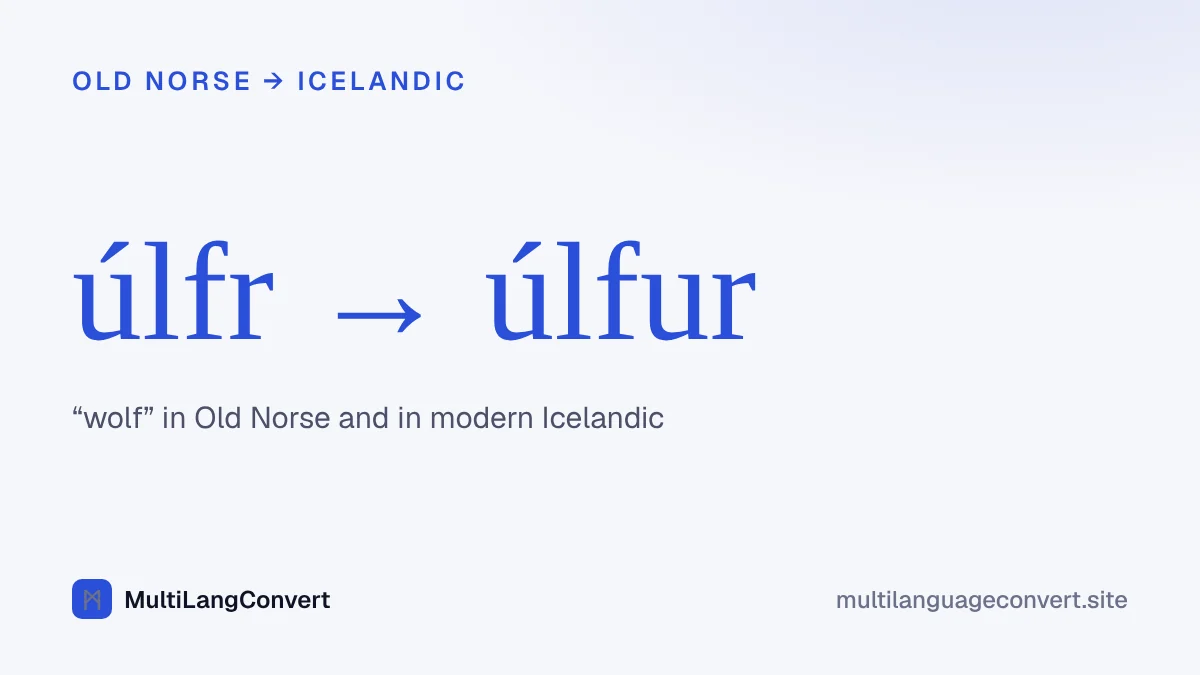
The short answer: Old Norse is the North Germanic language of the Viking Age and the medieval sagas, roughly 800–1350. Icelandic is its closest living descendant, and modern Icelanders can read the sagas with some effort because spelling and grammar changed relatively little. “Nordic” isn’t a language at all; it’s a region. For a Viking-era phrase, use Old Norse. For a phrase a living person will read, use modern Icelandic, Norwegian, Swedish or Danish.
What is Old Norse?
Old Norse is the language spoken in Scandinavia and its settlements during the Viking Age and the Middle Ages. Encyclopaedia Britannica describes it as the ancestor of modern Icelandic, Faroese, Norwegian, Swedish and Danish.
It had two main branches. Old West Norse was spoken in Norway and the Atlantic settlements: Iceland, the Faroes, Orkney, Shetland and Greenland. Old East Norse was spoken in Denmark and Sweden. Most surviving literature, including the Icelandic sagas and the Poetic Edda, is in Old West Norse, usually in its Icelandic form, so “Old Norse” in textbooks means that variety.
Vikings carved their language in runes, mostly the 16-letter Younger Futhark. The sagas themselves were written down later, in the 13th and 14th centuries, in the Latin alphabet with extra letters such as þ, ð and æ.
Is Icelandic the same as Old Norse?
No, but it’s very close. Icelandic is the modern language that changed least from Old Norse, especially in grammar. It still has four cases, three genders and similar verb forms.
The biggest changes are in pronunciation, not spelling. Icelandic kept a spelling based on medieval manuscripts, so a modern Icelander sees familiar words when reading a saga, even though the vowels sound very different from how a Viking would have said them. The Árni Magnússon Institute for Icelandic Studies, which looks after the medieval manuscripts, publishes many saga texts in modernised spelling for this reason.
| English | Old Norse | Modern Icelandic | Norwegian (Bokmål) | Swedish |
|---|---|---|---|---|
| wolf | úlfr | úlfur | ulv | ulv |
| sea | sær / marr | sær / haf | sjø / hav | sjö / hav |
| king | konungr | konungur | konge | kung |
| house | hús | hús | hus | hus |
| brother | bróðir | bróðir | bror | bror |
| to go | ganga | ganga | gå | gå |
The table shows the pattern clearly. Icelandic often adds a -u- before a final -r (úlfr → úlfur) but otherwise keeps the old forms, while the mainland languages shortened and simplified them.
What is an “English to Nordic” translation?
“Nordic” refers to the Nordic countries: Denmark, Finland, Iceland, Norway and Sweden, plus the Faroes, Greenland and Åland. It isn’t a language, and the region includes Finnish, which isn’t even related to Norse.
People who search for “English to Nordic” usually mean one of three things:
- Viking language → Old Norse.
- A modern Scandinavian language → Icelandic, Norwegian, Swedish or Danish, depending on the country.
- Runes → Old Norse written in the Younger Futhark, or Proto-Norse in the older Elder Futhark.
How to translate English into Old Norse
- Find the Old Norse words in a dictionary. Cleasby and Vigfusson’s Icelandic-English Dictionary (1874) and the Dictionary of Old Norse Prose at the University of Copenhagen are the standard references.
- Choose the right case. Old Norse has nominative, accusative, dative and genitive. “The wolf” as subject is úlfrinn; as object it is úlfinn.
- Attach “the” to the noun. Old Norse had no separate “the” in front; it added -inn, -in or -it to the end of nouns, which is why Swedish and Norwegian still do the same.
- Conjugate the verb for person and number: ek fer (I go), þú ferr (you go), vér fǫrum (we go).
- Write it in runes if you want, following Viking spelling conventions rather than letter-by-letter conversion.
Our Old Norse Translator applies these steps: it translates from an Old Norse dictionary with case and verb endings and can show the result in Younger Futhark runes.
Example: use a real saying when one exists
The poem Hávamál (“Sayings of the High One”) in the Poetic Edda is full of Old Norse wisdom. Stanza 76 begins Deyr fé, deyja frændr, “Cattle die, kinsmen die”, and ends with the idea that a good reputation never dies. If your English idea matches a real line like this, quote the original rather than translating the English word by word.
Old Norse words you already know
English borrowed hundreds of everyday words from Old Norse during the Viking settlement of England. Sky, egg, knife, window (from vindauga, “wind-eye”), husband and even they, them and their came from Norse. Our post on Old Norse words in English lists the most common.
Common mistakes with Old Norse translations
- Using modern Icelandic spelling and calling it Old Norse. The two are close, but forms like -ur endings mark modern text.
- Ignoring case. A name or noun in the wrong case reads as ungrammatical.
- Converting letters to runes one by one. Viking writers spelled by sound and used one rune for several sounds.
- Treating “Nordic” as one language. Danish, Swedish and Icelandic differ as much as Spanish, Italian and Portuguese.
- Inventing compound “Viking” words. Kennings like hval-vegr (“whale-road”, the sea) are real, but new ones should follow attested patterns.
Putting it together
Old Norse is the language of the Vikings and the sagas; Icelandic is its closest living relative and still looks much like it on the page. “Nordic” is a region, not a language. Pick Old Norse for Viking-era text, use a dictionary such as Cleasby-Vigfusson or the Dictionary of Old Norse Prose, apply the case endings, and write runes by sound.
Sources
- Encyclopaedia Britannica, “Old Norse language“.
- University of Copenhagen, A Dictionary of Old Norse Prose (ONP).
- Árni Magnússon Institute for Icelandic Studies, Reykjavík.
- Richard Cleasby and Gudbrand Vigfusson, An Icelandic-English Dictionary (Clarendon Press, 1874).
- Michael Barnes, A New Introduction to Old Norse, Part I: Grammar (Viking Society for Northern Research, 2008).
- Jesse Byock, Viking Language 1 (Jules William Press, 2013).