Sumerian vs Akkadian: What Language Is Cuneiform?
“Cuneiform” isn’t a language. It’s a writing system made of wedge-shaped marks pressed into clay, and over 3,000 years it was used to write more than a dozen languages. The two most important were Sumerian and Akkadian, and they couldn’t be more different.
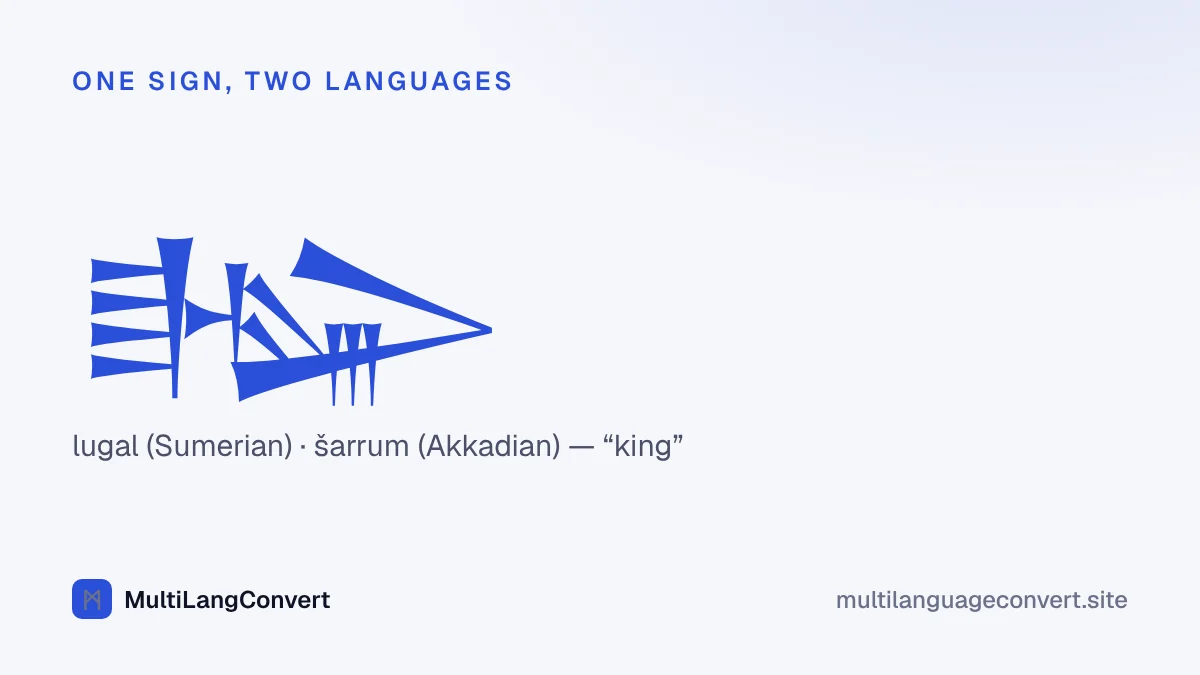
The short answer: Sumerian is the oldest language written in cuneiform, from about 3200 BC. It’s a language isolate with no known relatives. Akkadian is a Semitic language, related to Hebrew and Arabic, that took over cuneiform from about 2350 BC and became the language of Babylon and Assyria. When people ask for a “cuneiform translator”, they usually need to choose one of the two.
What is cuneiform?
Cuneiform is the script invented in southern Mesopotamia, in what is now Iraq, at the end of the 4th millennium BC. Scribes pressed a cut reed into wet clay, leaving wedge-shaped marks; the name comes from Latin cuneus, “wedge”.
It began as pictures for counting goods and grew into a full writing system with several hundred signs. Some signs stand for whole words, some for syllables, and some are silent markers that tell the reader what kind of word follows. The Cuneiform Digital Library Initiative catalogues hundreds of thousands of tablets and fragments from museum collections worldwide.
For a deeper look at the signs themselves, see our guide to how cuneiform works.
What is Sumerian?
Sumerian was the language of Sumer, the cities of southern Mesopotamia such as Uruk, Ur, Lagash and Nippur. Encyclopaedia Britannica calls it a language isolate and “the oldest written language in existence”.
Sumerian is an isolate: it isn’t related to any other known language. It’s also agglutinative, meaning it builds words by stacking small pieces in a fixed order. A single verb can carry markers for subject, object, direction and mood.
It stopped being spoken around 2000–1800 BC, but scribes kept writing it for religious and literary texts for another 1,500 years, much as Latin was used in medieval Europe.
What is Akkadian?
Akkadian is an East Semitic language named after the city of Akkad, capital of Sargon’s empire around 2350 BC. Britannica notes it was spoken in Mesopotamia from the 3rd to the 1st millennium BC, in two main dialects: Babylonian in the south and Assyrian in the north. Around 2000 BC it replaced Sumerian as the spoken language of southern Mesopotamia.
Akkadian borrowed cuneiform from the Sumerians and adapted it, even though the script fitted Semitic sounds poorly. It became the international language of diplomacy: the Amarna letters, exchanged between Egypt’s pharaohs and the kings of the Near East in the 14th century BC, are written in Akkadian.
The Epic of Gilgamesh, the Code of Hammurabi and the Babylonian creation story Enūma Eliš are all in Akkadian.
Sumerian vs Akkadian: key differences
| Feature | Sumerian | Akkadian |
|---|---|---|
| Language family | Isolate (no relatives) | Semitic (like Hebrew, Arabic) |
| Earliest writing | c. 3200 BC | c. 2400 BC |
| Last spoken | c. 2000–1800 BC | c. 600 BC–1st century AD (replaced by Aramaic) |
| Word building | Stacked prefixes and suffixes | Three-consonant roots with vowel patterns |
| Word order | Subject-object-verb | Subject-object-verb, unusual for a Semitic language and probably from Sumerian influence |
| Famous texts | Temple hymns, Sumerian King List, Gilgamesh poems | Epic of Gilgamesh, Code of Hammurabi |
| Main dictionary | ePSD (Pennsylvania Sumerian Dictionary) | Chicago Assyrian Dictionary |
The same word in each
| English | Sumerian | Akkadian | Sign |
|---|---|---|---|
| god | dingir | ilum | 𒀭 |
| king | lugal (“big man”) | šarrum | 𒈗 |
| house, temple | e₂ | bītum | 𒂍 |
| water | a | mû | 𒀀 |
| city | uru | ālum | 𒌷 |
Notice that one sign can be read in either language. Akkadian scribes often wrote a Sumerian sign but read it aloud as the Akkadian word, a practice scholars call a Sumerogram. So 𒈗 on an Assyrian tablet was read šarrum, not lugal.
Which should a cuneiform translator use?
Pick the language that matches your purpose.
- For the “first civilisation” and the oldest texts: Sumerian.
- For Babylon, Assyria, Hammurabi or Gilgamesh: Akkadian.
- For a name spelled in cuneiform: use syllable signs, which work for either language.
Our Sumerian Translator translates English words and short sentences into Sumerian from a dictionary of attested words and shows each one in cuneiform signs with a transliteration. Sumerian vocabulary is limited to what survives on tablets, so unknown words are flagged rather than invented.
How do scholars translate Sumerian today?
Translating Sumerian is a specialist job, and the main reference works are freely available online.
- The Electronic Text Corpus of Sumerian Literature (University of Oxford) – about 400 literary compositions with English translations.
- CDLI – photos, transliterations and catalogue data for hundreds of thousands of tablets.
- The Chicago Assyrian Dictionary – 26 volumes for Akkadian, completed in 2010 and free as PDFs.
Even experts disagree on some readings, because many signs have several values and Sumerian grammar is still being worked out. Treat any translation, including ours, as a careful draft.
Common mistakes with cuneiform translations
- Calling cuneiform a language. It’s a script used for Sumerian, Akkadian, Hittite, Elamite and others.
- Using Akkadian words in a “Sumerian” text. They’re unrelated languages.
- Using a font with the wrong period’s sign shapes. Early Sumerian signs and Neo-Assyrian signs look very different.
- Translating modern words. There’s no attested Sumerian word for “computer”; a good translator says so.
Putting it together
Cuneiform is the script; Sumerian and Akkadian are two of the languages it wrote. Sumerian is the older, unrelated isolate of the first cities. Akkadian is the Semitic language of Babylon and Assyria that borrowed the script and spread it across the Near East. Decide which world your text belongs to, then check the result against ETCSL or the Chicago Assyrian Dictionary.
Sources
- Encyclopaedia Britannica, “Sumerian language” and “Akkadian language“.
- Cuneiform Digital Library Initiative.
- University of Oxford, Electronic Text Corpus of Sumerian Literature.
- University of Chicago, Institute for the Study of Ancient Cultures, The Assyrian Dictionary (CAD).
- Irving Finkel and Jonathan Taylor, Cuneiform (British Museum Press, 2015).
- John Huehnergard, A Grammar of Akkadian (3rd ed., Eisenbrauns, 2011).