How Do You Translate Middle English to Modern English?
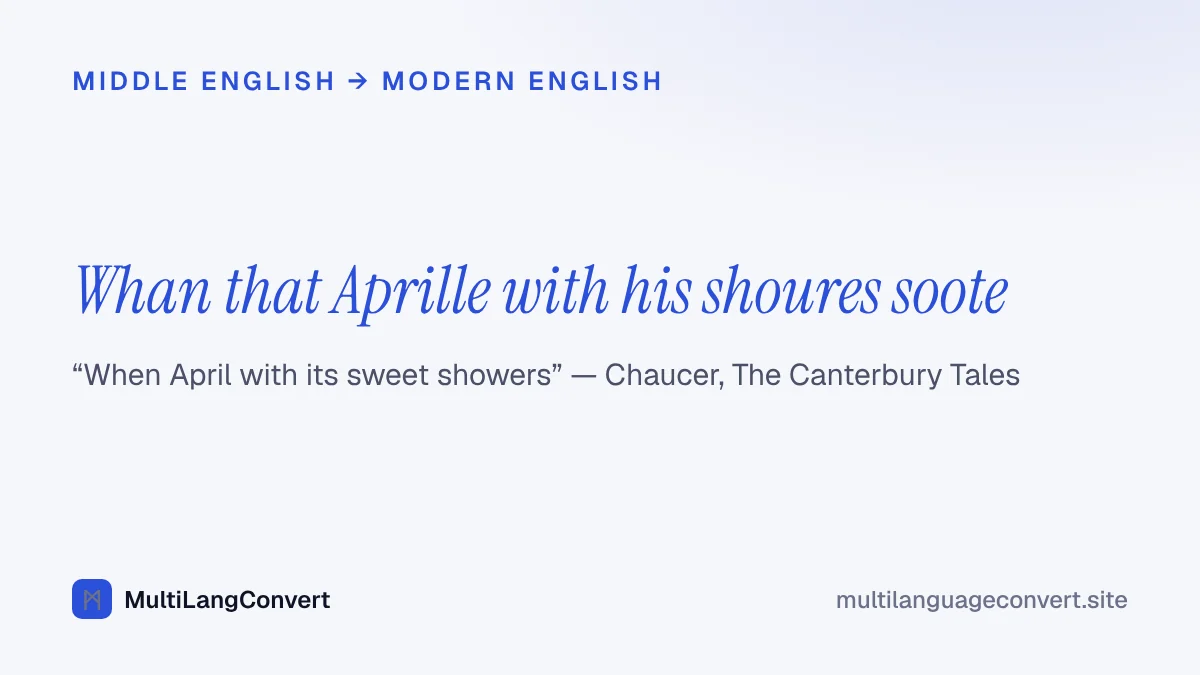
You open The Canterbury Tales and the first line reads: “Whan that Aprille with his shoures soote.” You can almost read it, yet it doesn’t quite make sense. That gap is what Middle English is like. It is English, spoken from about 1100 to 1500, with older spelling, a few lost words and grammar that sits halfway between Old English and today’s language.
The short answer: to translate Middle English into modern English, you modernise the spelling, look up the “false friends” whose meanings have shifted, and smooth out word order and verb endings. Most of the vocabulary is still recognisable, so a good glossary takes you further than a full translation does. This guide shows the method, step by step, with real examples from Chaucer.
What is Middle English?
Middle English is the form of English used in England from roughly the Norman Conquest of 1066 until the late 15th century. Encyclopaedia Britannica dates it from about 1100 to 1500, after Old English and before Early Modern English.
Two big forces shaped it. First, after 1066 Norman French became the language of the court, law and the church’s administration, so thousands of French words entered English. Second, the complex word endings of Old English wore away, so English came to rely on word order and small words like of, to and by to show meaning.
There was no single standard. A text from Kent, one from Yorkshire and one from London could spell the same word three different ways. Chaucer wrote in the London dialect, which is the main ancestor of modern standard English, so his work is the easiest place to start.
Can you read Middle English without a translator?
Yes, with practice, most modern English speakers can read late Middle English such as Chaucer with a glossary. Early Middle English from the 1100s and 1200s is much harder, because it is closer to Old English.
The Harvard Chaucer site, maintained by the university’s English department, notes that the main hurdles are spelling, pronunciation and a small set of changed words, not a foreign grammar. Its Geoffrey Chaucer Website gives interlinear translations so you can compare line by line.
Here is what most people miss: the hardest words are not the strange-looking ones. A word like soote (sweet) is easy to look up because you know you don’t know it. The danger is a word like nice, which looks modern but meant “foolish” in Chaucer’s time.
How to translate Middle English to modern English, step by step
The method that works best is to move from sound to meaning. Each step fixes one kind of difference.
- Read it aloud. Many spellings make sense once you hear them. Shoures becomes “showers” and knyght becomes “knight”, but say the k and the gh.
- Modernise the spelling. Swap y for i (wyf → wife), u or v as needed (loue → love), and drop final -e (soote → soot, then sweet).
- Fix the verb endings. Change -eth to -s (he loveth → he loves) and -en plurals to plain forms (they singen → they sing).
- Check the false friends. Look up any familiar word that doesn’t fit the sentence, using the Middle English Dictionary from the University of Michigan.
- Reorder if needed. Move verbs and objects into modern order, and add words the original left implied.
- Read the result aloud again. If it sounds natural and the meaning matches the original, you’re done.
A worked example
Take the opening of the General Prologue to The Canterbury Tales:
| Middle English | Modern English |
|---|---|
| Whan that Aprille with his shoures soote | When April with its sweet showers |
| The droghte of March hath perced to the roote | Has pierced the drought of March to the root |
| And bathed every veyne in swich licour | And bathed every vein in such liquid |
| Of which vertu engendred is the flour | By whose power the flower is brought forth |
Notice what changed. Whan that is just “when”. His means “its”, because Middle English used his for things as well as men. Vertu means “power”, not moral goodness, and engendred is needs a modern word order.
Middle English false friends: words that changed meaning
False friends are the most common cause of mistranslation. They look modern, so readers don’t check them.
| Middle English word | Meaning then | Meaning now |
|---|---|---|
| nice | foolish, simple | pleasant |
| sely (silly) | blessed, innocent | foolish |
| wif (wife) | woman | married woman |
| girl | a young person of either sex | a young female |
| deer | any animal | a deer |
| meat | food in general | animal flesh |
| sad | steadfast, serious | unhappy |
| lewed (lewd) | unlearned, lay | crude |
The Middle English Dictionary lists each sense with dated quotations, so you can check which meaning was current when your text was written.
How was Middle English pronounced?
Middle English was pronounced much closer to its spelling than modern English is. Letters that are now silent were spoken.
- Every consonant counts. The k in knyght and the w in write were pronounced.
- gh was a throaty sound, like the ch in Scottish loch, so night sounded like “nicht”.
- Long vowels had their “continental” values. Lyf (life) sounded like “leaf”, and hous (house) like “hoose”.
- Final -e was often spoken as a light “uh”, especially in verse, where it can be needed for the rhythm.
The shift to today’s vowels is called the Great Vowel Shift, which ran roughly from the 1400s to the 1700s. Harvard’s page on Middle English pronunciation and grammar gives a full table with audio.
Grammar differences you’ll meet most often
Middle English grammar is close to ours, but a handful of patterns appear in almost every text.
| Feature | Middle English | Modern English |
|---|---|---|
| Third-person verbs | he speketh | he speaks |
| Plural verbs | they speken | they speak |
| “You” (one person, familiar) | thou, thee, thy | you, your |
| “You” (plural or polite) | ye, you, youre | you, your |
| Double negatives | he nevere yet no vileynye ne sayde | he never said anything rude |
| Questions | Knowe ye this man? | Do you know this man? |
| “Its” | his | its |
Double and even triple negatives were normal and simply added emphasis. Chaucer’s line about the Knight stacks four of them, and it means he never spoke rudely to anyone.
Middle English vs Old English vs Early Modern English
People often mix up the three stages, and translators for one don’t work well for the others.
| Stage | Dates (approx.) | Famous text | Readable today? |
|---|---|---|---|
| Old English | 450–1100 | Beowulf | No, needs study |
| Middle English | 1100–1500 | The Canterbury Tales | Partly, with a glossary |
| Early Modern English | 1500–1700 | Shakespeare, King James Bible | Yes, with a few notes |
If your text has letters like þ (thorn) and æ (ash) and very few French words, it is probably Old English. Our guide to how Old English differs from Middle English shows how to tell them apart.
Which tools and dictionaries should you use?
The best results come from combining a dictionary, a parallel translation and an automatic first draft.
- Middle English Dictionary (University of Michigan) – the standard historical dictionary, free online, with over 50,000 entries and dated quotations.
- Harvard’s Geoffrey Chaucer Website – interlinear translations of the Canterbury Tales and pronunciation help.
- The Oxford English Dictionary – traces every sense of a word through time, useful for false friends.
- A modern-to-Middle English converter – going the other way, our Middle English Translator turns modern sentences into Chaucer-style English with -eth verbs, thou forms and period spelling, which helps you learn the patterns.
Translation tools give a draft. For a published edition, a quotation or anything permanent, check every word against the dictionary.
Common mistakes when translating Middle English
- Reading his as “his” every time. For objects and animals it usually means “its”.
- Treating thou as formal. It was the familiar or intimate form; ye was polite.
- Ignoring the final -e in poetry. Dropping it can break the metre of a line.
- Translating too literally. “Whan that” is just “when”; keeping “when that” sounds wrong in modern English.
- Assuming one spelling. The same scribe could write yt, it and hit on a single page.
Putting it together
Go back to that opening line. “Whan that Aprille with his shoures soote” becomes “When April with its sweet showers” once you hear the spelling, fix his and look up soote. That is the whole method in one line: sound it out, modernise, check the false friends and smooth the word order.
Start with Chaucer, keep the Middle English Dictionary open in another tab, and read short passages aloud. After a few pages, the patterns become familiar, and you’ll need the dictionary less and less.
Working on a specific passage? Bookmark this guide and the false-friends table; they cover most of the problems readers hit.
Sources
- Encyclopaedia Britannica, “Middle English language“.
- University of Michigan, Middle English Dictionary (Middle English Compendium).
- Harvard University, Geoffrey Chaucer Website, and “Middle English Basic Pronunciation and Grammar“.
- Oxford English Dictionary, historical senses of nice, silly and girl.
- Geoffrey Chaucer, The Canterbury Tales, General Prologue, lines 1–4 and 70–71 (Riverside Chaucer text).
- Albert C. Baugh and Thomas Cable, A History of the English Language (6th ed., Routledge, 2013), chapters on Middle English and the Great Vowel Shift.