Sindarin vs Quenya: Which Elvish Language Should You Use?
When Frodo’s party reaches the doors of Moria, the riddle is solved with one Elvish word: mellon, “friend”. J. R. R. Tolkien didn’t invent Elvish for decoration. He was a professional philologist, and he built whole languages, with sound changes and grammar, before writing the stories set in them.
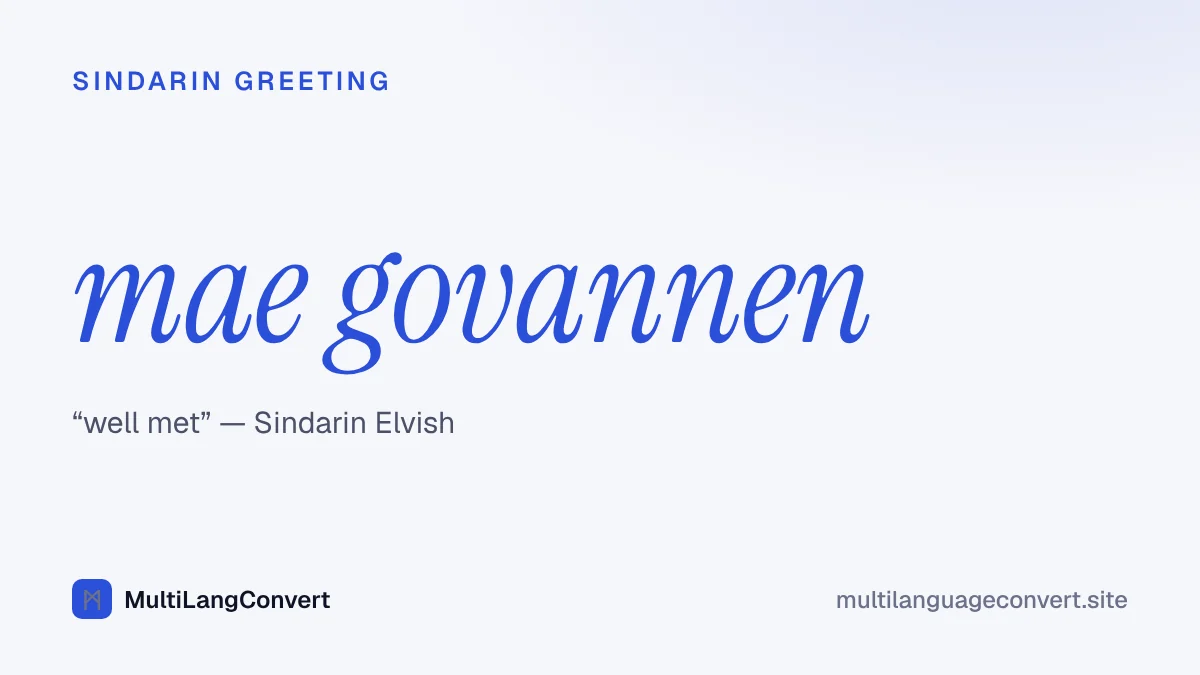
The short answer: Tolkien’s two main Elvish languages are Sindarin and Quenya. Sindarin is the everyday Elvish of Middle-earth in The Lord of the Rings, used for names like Gondor and phrases like mae govannen (“well met”). Quenya is the ancient, formal “Elven Latin”, used for poetry and ceremony, as in Galadriel’s lament Namárië. For most Lord of the Rings phrases, Sindarin is the right choice.
Who created Elvish?
Tolkien (1892–1973), Professor of Anglo-Saxon at Oxford, began inventing languages as a teenager and worked on them all his life. He described his stories as partly a home for those languages. Quenya drew on the sound of Finnish, Latin and Greek; Sindarin was modelled on the sound and sound-changes of Welsh.
Much of what we know comes from Tolkien’s unpublished notes, edited since the 1990s in the journals Vinyar Tengwar and Parma Eldalamberon. The scholarly lexicon Eldamo, compiled by Paul Strack, collects every attested word with its source.
Sindarin vs Quenya: key differences
| Feature | Sindarin | Quenya |
|---|---|---|
| Role in Middle-earth | Everyday speech of the Elves of Middle-earth | Ancient language of lore and ceremony |
| Sound model | Welsh | Finnish, Latin, Greek |
| Grammar | Initial consonant mutations, vowel-change plurals | Many case endings |
| Plural of “elf” | edhel → edhil | elda → eldar |
| “Star” | gîl / êl | elen |
| Famous phrase | mae govannen (well met) | elen síla lúmenn’ omentielvo (a star shines on the hour of our meeting) |
| Place names | Gondor, Mordor, Rivendell (Imladris) | Valinor, Númenor |
Well-known Elvish words and phrases
| Elvish | Language | Meaning |
|---|---|---|
| mellon | Sindarin | friend |
| mae govannen | Sindarin | well met |
| le hannon | Sindarin | thank you (to you) |
| namárië | Quenya | farewell |
| Elbereth | Sindarin | star-queen, a name of Varda |
| Anor / Ithil | Sindarin | sun / moon |
| galad | Sindarin | light, radiance |
| meleth | Sindarin | love |
Because Tolkien never finished either language, some everyday words simply don’t exist. Fans fill gaps with “Neo-Sindarin” coinages; Eldamo marks which words are Tolkien’s and which are reconstructions.
How does Sindarin grammar work?
- Mutation. The first sound of a word changes after certain words, as in Welsh: tâl (foot) but i dâl (the foot).
- Plurals by vowel change. adan (man) → edain; orch (orc) → yrch.
- Adjectives usually follow nouns. Ered Luin, the Blue Mountains, is literally “mountains blue”.
- The article is i (plural in): i-mellon, the friend.
How to translate English into Elvish
- Decide Sindarin or Quenya based on setting and tone.
- Use Tolkien’s own words first, checked in Eldamo.
- Apply mutations and plurals (Sindarin) or case endings (Quenya).
- Mark reconstructed words if you need words Tolkien didn’t create.
- Write it in Tengwar, the Elvish script Tolkien designed, if you want the authentic look.
Our Elvish (Sindarin) Translator translates into Sindarin using Tolkien’s attested words first, and tells you when a word had to be kept in English.
Elvish and real languages
Tolkien’s professional work on Old English and Old Norse shaped Middle-earth deeply: the dwarf names in The Hobbit come from the Old Norse poem Völuspá, and the Riders of Rohan speak a language represented by Old English. See Old Norse vs Icelandic for the real Norse behind those names.
Putting it together
Sindarin is the living Elvish of Middle-earth, Welsh-sounding and full of mutations; Quenya is the ancient, Finnish-flavoured tongue of lore. Choose Sindarin for most Lord of the Rings phrases, prefer Tolkien’s own words from Eldamo, and be honest about any reconstructed ones.
Sources
- Paul Strack, Eldamo: An Elvish Lexicon.
- J. R. R. Tolkien, The Lord of the Rings (1954–55), Appendices E and F.
- J. R. R. Tolkien, “A Secret Vice”, in The Monsters and the Critics and Other Essays (1983).
- Parma Eldalamberon and Vinyar Tengwar (Elvish Linguistic Fellowship), editions of Tolkien’s linguistic papers.
- Humphrey Carpenter, ed., The Letters of J. R. R. Tolkien (1981).