What Is the Gothic Alphabet? All 27 Letters Explained
“Gothic” can mean blackletter fonts, dark fashion or a 19th-century novel. But the original Gothic alphabet is something else entirely: a real script created in the 4th century AD for the Goths, a Germanic people, so they could read the Bible in their own language.
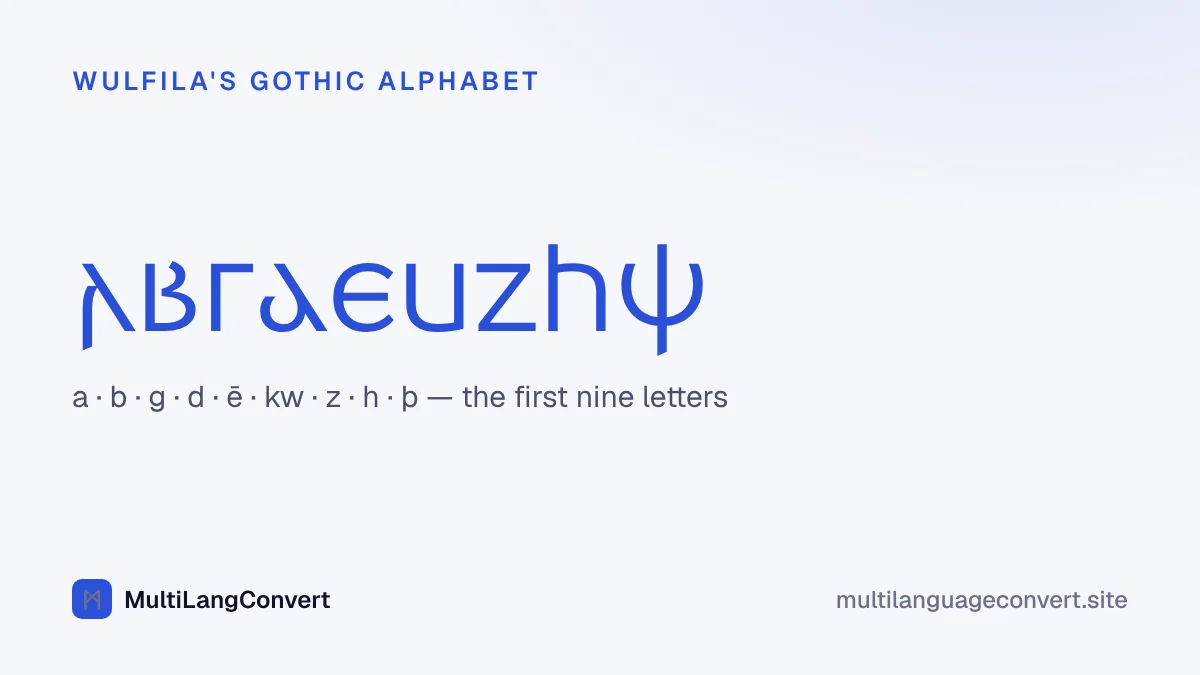
The short answer: the Gothic alphabet was created around AD 350 by Bishop Wulfila (Ulfilas) to translate the Bible into the Gothic language. It has 27 letters, mostly based on Greek, with a few from Latin and the runes, and each letter also had a number value. It has nothing to do with “Gothic” blackletter fonts, which are a medieval style of the Latin alphabet.
Who created the Gothic alphabet?
Wulfila (c. 311–383) was a bishop of Gothic and Greek heritage who worked among the Goths north of the Danube. Encyclopaedia Britannica credits him with the 4th-century translation of the Bible into Gothic, the oldest substantial text in any Germanic language, and ancient church historians such as Philostorgius and Socrates of Constantinople credit him with inventing the alphabet for it.
The most famous surviving copy is the Codex Argenteus, the “Silver Bible”, written in silver and gold ink on purple parchment in 6th-century Italy. It’s held at Uppsala University Library in Sweden and is listed in UNESCO’s Memory of the World Register.
The Gothic alphabet: all 27 letters
| Letter | Name | Sound | Number |
|---|---|---|---|
| 𐌰 | ahsa | a | 1 |
| 𐌱 | bairkan | b | 2 |
| 𐌲 | giba | g | 3 |
| 𐌳 | dags | d | 4 |
| 𐌴 | aiƕs | ē | 5 |
| 𐌵 | qairþra | kw | 6 |
| 𐌶 | ezec | z | 7 |
| 𐌷 | hagl | h | 8 |
| 𐌸 | þiuþ | th | 9 |
| 𐌹 | eis | i | 10 |
| 𐌺 | kusma | k | 20 |
| 𐌻 | lagus | l | 30 |
| 𐌼 | manna | m | 40 |
| 𐌽 | nauþs | n | 50 |
| 𐌾 | jer | j | 60 |
| 𐌿 | urus | u | 70 |
| 𐍀 | pairþra | p | 80 |
| 𐍁 | — | (number only) | 90 |
| 𐍂 | raida | r | 100 |
| 𐍃 | sauil | s | 200 |
| 𐍄 | teiws | t | 300 |
| 𐍅 | winja | w | 400 |
| 𐍆 | faihu | f | 500 |
| 𐍇 | iggws | ch (kh) | 600 |
| 𐍈 | ƕair | hw | 700 |
| 𐍉 | oþal | ō | 800 |
| 𐍊 | — | (number only) | 900 |
The letter names come from a 9th-century manuscript now in Vienna (the Salzburg-Vienna Alcuin manuscript), in garbled spellings that scholars have reconstructed, and many match the rune names: faihu and fehu (wealth), dags and dagaz (day), manna and mannaz (man). The Unicode Gothic chart encodes all 27 letters.
Where did the letters come from?
- Greek supplied most shapes and the alphabetic order: 𐌰 from Α, 𐌱 from Β, 𐌲 from Γ.
- Latin supplied a few, such as 𐍂 (R) and 𐍃 (S).
- Runes probably supplied shapes like 𐌿 (u, from ᚢ) and 𐍉 (ō, from ᛟ).
Gothic language basics
Gothic is an East Germanic language, the only one known from extended texts. It’s important for linguists because it preserves many Proto-Germanic features that later languages lost, such as full case endings: dags (day), fadar (father), atta (father, informal). The Lord’s Prayer begins Atta unsar þu in himinam, “Our Father, who art in heaven”. For the shared ancestor, see what is Proto-Germanic?
How to write English in the Gothic alphabet
- Spell by sound, not English spelling: “Thomas” → t-o-m-a-s.
- Use 𐌸 for th and 𐍈 for hw (as in old “which”).
- Map vowels: a → 𐌰, e → 𐌴, i → 𐌹, o → 𐍉, u → 𐌿.
- Skip silent letters.
Our Gothic Alphabet Translator converts English to Gothic letters by sound and shows each letter’s name and number value.
Putting it together
The Gothic alphabet is Wulfila’s 4th-century script for the Gothic Bible: 27 letters built mainly from Greek, with Latin and runic touches, each doubling as a number. It’s the script of the oldest long Germanic text and has nothing to do with blackletter fonts.
Sources
- Encyclopaedia Britannica, “Gothic language“.
- The Unicode Consortium, Gothic code chart (U+10330–U+1034F).
- UNESCO Memory of the World, “Codex Argenteus” nomination file.
- Joseph Wright, Grammar of the Gothic Language (Oxford, 1910).
- Wilhelm Braune, Gotische Grammatik (20th ed., Niemeyer, 2004).