From Phoenician to Latin: How the Alphabet Spread
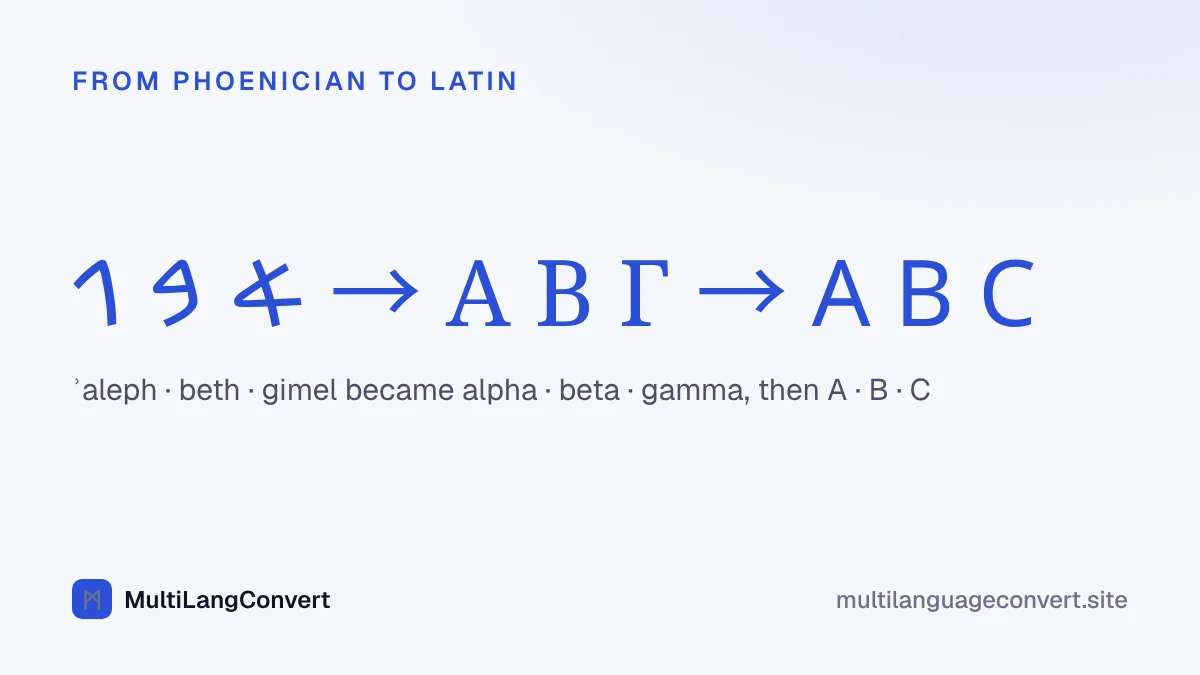
The alphabet you are reading started as the Phoenician script of the Levant, about 3,000 years ago. Greeks borrowed it and added vowels, Etruscans and Romans adapted the Greek version, and the Latin alphabet then spread across Europe and the world. Other branches of the same family gave rise to Hebrew, Arabic, Gothic and, most likely, the runes.
Before the alphabet
The first writing systems, Mesopotamian cuneiform and Egyptian hieroglyphs, appeared around 3300–3200 BC. Both used hundreds of signs, mixing word signs with signs for sounds. Learning them took years, and writing was a specialist skill. Our guides on How Cuneiform Works: Word Signs, Syllables and Determinatives and How to Read Egyptian Hieroglyphs: A Beginner's Guide explain how they worked.
The idea of the alphabet, a small set of signs that each stand for one sound, appears to have come from Semitic-speaking workers in Egypt and Sinai around 1800 BC. Inscriptions found at Serabit el-Khadim in Sinai and at Wadi el-Hol in Egypt use a few dozen simple pictures, many borrowed from hieroglyphs, to write consonants of a Semitic language. Each sign stood for the first sound of the thing it showed: a house (bayt) for b, water (maym) for m. This principle is called acrophony.
The Phoenician alphabet (about 1050 BC)
By about 1050 BC, the Phoenicians of coastal cities such as Byblos, Tyre and Sidon were using a standardised set of 22 letters, written right to left, all for consonants. Phoenician traders carried it around the Mediterranean, from Cyprus to Carthage and Spain. You can write in it with our Phoenician Alphabet Translator.
The Greek revolution: vowels (about 800 BC)
Greeks adopted the Phoenician letters around the 8th century BC. Greek needed written vowels more than Phoenician did, so the Greeks reused letters for Phoenician consonant sounds they did not have:
| Phoenician | Phoenician sound | Greek letter | Greek sound |
|---|---|---|---|
| 𐤀 ʾalf | glottal stop | Α alpha | a |
| 𐤄 he | h | Ε epsilon | e |
| 𐤇 ḥet | throaty h | Η eta | h, later long e |
| 𐤉 yod | y | Ι iota | i |
| 𐤏 ʿain | throat sound | Ο omicron | o |
| 𐤅 wau | w | Υ upsilon (and Ϝ digamma) | u (and w) |
This was the first alphabet to write every vowel as a full letter. Early Greek could be written right to left, left to right, or in alternating lines (boustrophedon, “as the ox turns”), before left to right became standard. Greek also added new letters at the end of the alphabet: Φ, Χ, Ψ and Ω. Our Greek Alphabet Converter converts between Greek and Latin letters.
From Greek to Latin
Greek colonists in southern Italy brought a western form of the Greek alphabet, which the Etruscans adopted around 700 BC. The Romans took it from them. That route explains several oddities of our alphabet:
- C and G. Etruscan had no g sound, so Greek gamma (Γ) was used for k and became C. The Romans later added a stroke to C to make G, in the 3rd century BC.
- F. It comes from the Greek letter digamma (Ϝ), which wrote a w sound and was dropped from standard Greek. Latin used it for f.
- H. Western Greek used eta (Η) for an h sound, as Phoenician did, and Latin kept that value.
- Y and Z. These were added to Latin in the 1st century BC to write Greek loanwords, which is why they sit at the end.
- J, U and W. These came much later, in medieval and early modern Europe, from variant forms of I and V.
Branches of the family
Aramaic, Hebrew and Arabic
Aramaic, the language of the Persian empire’s administration, used a script descended from Phoenician. From Aramaic writing came the square Hebrew script, Syriac, the Nabataean script that developed into Arabic, and many scripts of Central and South Asia.
Gothic
In the 4th century AD, Bishop Wulfila created a Gothic alphabet to translate the Bible. He based it mostly on Greek uncials, with some Latin letters and probably a few runes. Try it with our Gothic Alphabet Translator.
Runes
The runes of the Germanic peoples appear in the 2nd century AD. Most scholars think they were modelled on an Italic alphabet, either Latin or one of the North Italic scripts used in the Alps. Several shapes are close to Latin letters: ᚱ R, ᛒ B, ᛏ T. Our guide comparing the Elder Futhark vs Younger Futhark vs Futhorc: The Differences Explained picks up the story there.
Cyrillic
In the 9th century, followers of the missionaries Cyril and Methodius created the Cyrillic alphabet, mainly from Greek letters, for Slavic languages. It is now used for Russian, Ukrainian, Bulgarian, Serbian and many others.
Tracing three letters
| Latin | Greek | Phoenician | Earliest picture |
|---|---|---|---|
| A | Α alpha | 𐤀 ʾalf (“ox”) | an ox’s head; turn A upside down to see the horns |
| B | Β beta | 𐤁 bet (“house”) | a floor plan of a house |
| M | Μ mu | 𐤌 mem (“water”) | waves of water |
The word “alphabet” itself is the first two Greek letter names, alpha and beta, which in turn are the Phoenician ʾalf and bet.
Sources
- The Unicode Consortium, Phoenician code chart
- The Unicode Consortium, Greek and Coptic code chart
- John Darnell et al., “Two Early Alphabetic Inscriptions from the Wadi el-Ḥôl” (2005).
- Peter T. Daniels and William Bright, eds., The World’s Writing Systems (Oxford University Press, 1996).
Frequently asked questions
Who invented the alphabet?
Why does the Latin alphabet have both C and K?
Tools for this
- Phoenician Alphabet TranslatorThe 22-letter ancestor of Greek, Latin and Hebrew.
- Greek Alphabet ConverterRead Ancient Greek in Latin letters, or spell names in Greek.
- Gothic Alphabet TranslatorWulfila's 4th-century alphabet for the Gothic Bible.
- Runic TranslatorWrite any name in the oldest runic alphabet, by sound.