What Is Ogham? Ireland’s Ancient Alphabet Explained
Along the edges of standing stones in Ireland, you can still see rows of short notches and lines cut more than 1,500 years ago. They’re Ogham, the earliest writing in Ireland, and once you know the system, you can read a name off a stone yourself.
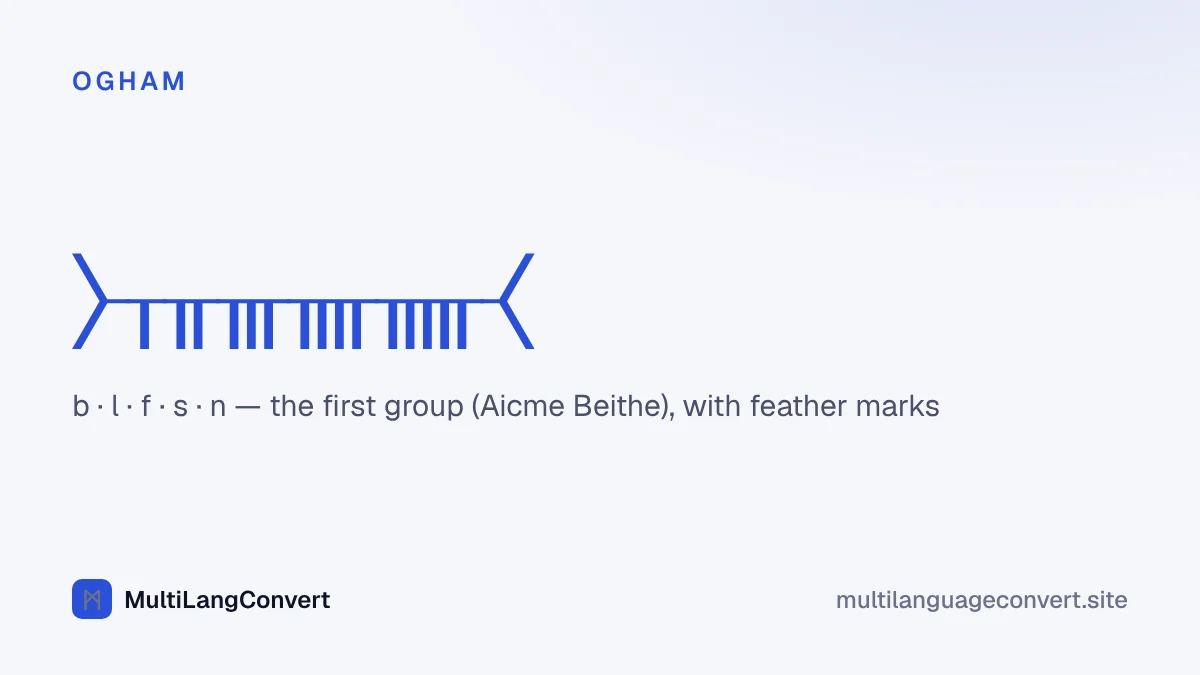
The short answer: Ogham is an alphabet of 20 main letters made of strokes and notches along a central line, used to write Primitive Irish from about the 4th to the 7th century AD. Most surviving inscriptions are on stone pillars and record a person’s name and lineage, such as “of X, son of Y”. Each letter has a name, many of them trees, which is why it’s sometimes called the “tree alphabet”.
Where is Ogham found?
About 400 Ogham stones survive, most in southern Ireland, especially Counties Kerry, Cork and Waterford, with others in Wales, Scotland, the Isle of Man and Cornwall. Maynooth University reports around 360 stones in Ireland alone. The Ogham in 3D project at the Dublin Institute for Advanced Studies has scanned many of them.
Inscriptions read from the bottom up, usually along a corner (edge) of the stone, which serves as the central line.
The Ogham alphabet: 20 letters in four groups
The letters fall into four groups (aicmí) of five, named after their first letter. Each group is cut on a different side of the line, or across it.
| Group | Letters | Strokes |
|---|---|---|
| Aicme Beithe | ᚁ b, ᚂ l, ᚃ f/v, ᚄ s, ᚅ n | 1–5 strokes on one side |
| Aicme hÚatha | ᚆ h, ᚇ d, ᚈ t, ᚉ c, ᚊ q | 1–5 strokes on the other side |
| Aicme Muine | ᚋ m, ᚌ g, ᚍ ng, ᚎ z, ᚏ r | 1–5 slanted strokes across |
| Aicme Ailme | ᚐ a, ᚑ o, ᚒ u, ᚓ e, ᚔ i | 1–5 notches or short strokes on the line |
Later, five extra letters called forfeda were added for sounds like ea and oi. The Unicode Ogham chart includes all of them plus the feather marks (᚛ ᚜) that open and close a text.
Is Ogham really a tree alphabet?
Partly. Medieval Irish scholars gave each letter a name, and many are trees: beith (birch) for b, coll (hazel) for c, dair (oak) for d, idad (yew) for i. But others aren’t trees at all, such as muin (perhaps “neck” or “trick”) and ngétal (perhaps “wounding”). The tree associations were elaborated in the medieval text Auraicept na nÉces (“The Scholars’ Primer”), long after the stones were carved.
Like the rune names in the Elder Futhark, the Ogham names were labels for letters, and later writers added layers of meaning.
What do Ogham stones say?
Almost all stone inscriptions follow a formula: a name in the genitive case, “(the stone) of X”, often followed by MAQI (“son of”) and a father’s name, or AVI (“descendant of”) and an ancestor. A typical example is the Ballymorereagh stone, read as “Cellach son of Mac-Áine”. They probably marked graves or land boundaries.
How to write your name in Ogham
- Spell by sound. There’s no j, k, v (use f), w, x or y: “Kevin” becomes c-e-f-i-n.
- Write bottom to top if you’re vertical, or left to right if horizontal.
- Add feather marks at the start (᚛) and end (᚜).
- Keep strokes evenly spaced so groups of 1–5 can be counted.
Our Ogham Translator writes names in Ogham by sound, with feather marks and the forfeda letters, and shows a full chart to check each one.
Putting it together
Ogham is Ireland’s first writing: 20 letters of strokes and notches in four groups of five, cut along the edges of stones between about AD 400 and 700. Read from the bottom up, expect a name and “son of”, and remember that the tree names were added and expanded by later scholars.
Sources
- Dublin Institute for Advanced Studies, Ogham in 3D.
- Maynooth University, “The 360 stones which show off the earliest writing in Ireland“.
- The Unicode Consortium, Ogham code chart (U+1680–U+169F).
- Damian McManus, A Guide to Ogam (An Sagart, 1991).
- R. A. S. Macalister, Corpus Inscriptionum Insularum Celticarum, vol. 1 (Stationery Office, Dublin, 1945).