How the Vikings Used Runes: Runestones, Messages and Magic
The Vikings wrote with runes, but not the way films and tattoo shops suggest. They used a short alphabet of 16 runes called the Younger Futhark, carved it into stone, wood, bone and metal, and used it for memorials, ownership marks, messages, charms and the occasional joke. They did not write sagas in runes, and runes were not mainly a magic code. This guide explains what Viking runes were, how they were written and what the surviving inscriptions actually say.
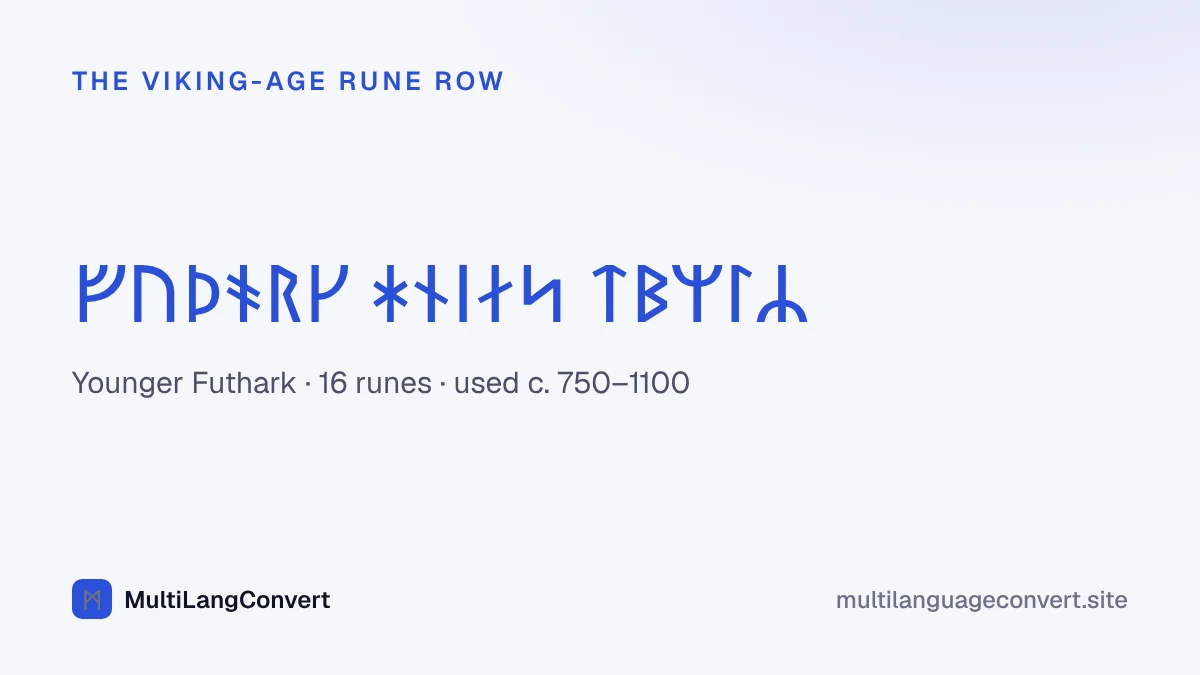
Which runes did the Vikings use?
Runes first appear around AD 150–200 in the 24-letter Elder Futhark. By the start of the Viking Age, around AD 800, Scandinavians had cut the row down to 16 runes, the Younger Futhark, even though their language, Old Norse, had more sounds than before. One rune now had to cover several sounds: ᚢ stood for u, o, ø, v and w, and ᛏ for both t and d. Readers worked out the right sound from context, much as we read “read” in two ways.
There were two main styles. Long-branch runes (sometimes called Danish runes) had full, clear strokes and were used on monuments. Short-twig runes (Swedish–Norwegian runes) used smaller marks that were quicker to carve on everyday wooden sticks. Our Younger Futhark Translator writes both, and our Elder Futhark vs Younger Futhark vs Futhorc: The Differences Explained compares the rune rows side by side.
Runestones: the Viking memorial
About 3,000 runestones survive from Scandinavia, most of them in Sweden and most from the late 10th and 11th centuries. Nearly all follow the same formula: X raised this stone in memory of Y, his father/son/brother. Many add who Y was, where he died and a short prayer.
- The Jelling stones in Denmark (c. 965) record King Harald Bluetooth, “who won for himself all of Denmark and Norway and made the Danes Christian”. They are sometimes called Denmark’s birth certificate.
- The Rök runestone in Sweden (early 9th century) carries the longest known runic inscription, about 760 runes, full of riddles and references to legends that scholars still debate.
- Around 26 Ingvar stones in Sweden remember men who died on Ingvar the Far-Travelled’s expedition east around 1041.
Runestones were public statements about family, land and inheritance, so they were painted in bright colours, set up beside roads and bridges, and often carved in an interlaced serpent design.
Everyday runes: sticks, bones and graffiti
Stones are only part of the story. Excavations at Bryggen, the old harbour of Bergen in Norway, turned up more than 600 inscriptions on wooden sticks from about 1150–1350. They include merchants’ name tags, business letters, prayers, love notes and lines such as “Gyða says that you should go home”. In the Hagia Sophia in Istanbul, a Norseman scratched the name “Halfdan” into a marble balustrade, and a marble lion from Piraeus, now in Venice, carries runes too. Runes were a working alphabet for ordinary people, not a secret held by priests.
Were runes magic?
Some inscriptions are clearly charms: words like alu on early amulets, curses on grave stones, or healing formulas on bones. The word rune itself comes from Proto-Germanic *rūnō, “secret, mystery”, and Old Norse poetry describes Odin winning the runes by hanging on the world tree. But the great majority of Viking inscriptions are practical. The modern idea of runes as a fortune-telling system owes more to 20th-century writers than to the Viking Age.
How runes were written
- Straight lines only. Runes avoid horizontal strokes, which would split along the grain of wood.
- Word dividers. Words were separated by dots or crosses (᛫ or ᛬) rather than spaces.
- Direction. Most inscriptions read left to right, but some run right to left or turn back and forth like a plough.
- Double letters were usually written once, and spelling was by sound, so the same name can appear in several forms.
Write your own Viking runes
To write a name, spell it by sound with the Younger Futhark Translator or follow our How to Write Your Name in Runes (and Avoid Common Mistakes). To write a real Old Norse phrase rather than English in runes, use the Old Norse Translator, which translates into Old Norse and shows the result in Younger Futhark runes as well. For the older Germanic period before the Vikings, the Proto-Germanic Translator writes in Elder Futhark.
Sources
- Scandinavian Runic-text Database, Uppsala University.
- UNESCO World Heritage Centre, “Jelling Mounds, Runic Stones and Church“.
- The Unicode Consortium, Runic code chart
- Michael P. Barnes, Runes: A Handbook (2012).
- Terje Spurkland, Norwegian Runes and Runic Inscriptions (2005).